Last night, the Liberty Aviation Museum rang in 2019 with the Tom Daugherty Orchestra during the museum's 4th annual New Year's Eve 1940's Big Band Victory Canteen Hangar Dance. The Liberty Aviation Museum is the official home of the Hogan's Heroes uniforms and props display, and the orchestra performed the Hogan's Heroes theme song! I love it and wish I could have been there!
I love everyone at the Liberty Aviation Museum, and I'll return to the museum in 2019 for more presentations about Bob Crane and book signings of Bob Crane: The Definitive Biography. I'll announce dates soon. Visiting the museum is always a highlight of the year for me because I get to see old friends and make new friends, too, so I hope to see you there!
There will also be a big announcement sometime in 2019. But no spoilers...! (Yes, I've been binge-watching Doctor Who!) Stay patient. All in good time.
We wish you peace, love, health, happiness, and all the best for 2019 and beyond! —Carol
It's the holidays! And like many people, I'm in the holiday spirit! I love everything there is to love about the season—spending extra time with family and friends, sending cards to loved ones near and far, surprising people with gifts, and finding it in my heart to be kinder than necessary and remembering those less fortunate. Christmas music and holiday lights and decorations spruce up my cozy home as I go about cookie baking and gift wrapping. And at night, thanks to modern technology, I can flick on any streaming service and find an array of nostalgic holiday movies and television shows from years gone by. From Rudolph to Frosty to Charlie Brown, and from It's a Wonderful Life to Elf to White Christmas to A Christmas Story, the holidays just don't seem complete until those iconic programs and films play in my home.
For Hogan's Heroes fans, a never-miss in the holiday line up is The Hollywood Palace Christmas Special, which aired on ABC on December 25, 1965. Bob Crane and the cast of Hogan's Heroes are prominently featured in the variety holiday show, hosted by Bing Crosby. Below is the preserved film, along with the program listing, which—fortunately for us—are made available by The Hollywood Palace.
The Hollywood Palace Christmas Special (December 25, 1965)
Bing Crosby: "White World of Winter"
Bob Crane, Bing Crosby and Dorothy Collins: "We Wish You the Merriest"
Bing Crosby and Dorothy Collins: "Glow Worm"
Fred Waring and his Pennsylvanians: "Twelve Days of Christmas"
Robert Clary: "French Christmas Song"
Werner Klemperer and John Banner: "Stille Nacht" ("Silent Night" in German)
Andre Tahon (puppeteer)
Bob Williams and Louie the Dog (humorous animal act): Overly enthusiastic man tries to get his lazy dog to do tricks.
The cast of Hogan's Heroes (Bob Crane, Werner Klemperer, Richard Dawson, John Banner, Robert Clary, Larry Hovis, and Ivan Dixon) joins Bing in a sketch.
Of course, Bing Crosby, who was a regular host of The Hollywood Palace, also produced and owned Hogan's Heroes. John Banner referred to him as "der Bingle" in this Christmas Special. Banner's affectionate nickname for Crosby is used to this day, and perhaps by some who are unaware of its origins.
While it's fairly well known that the main cast of Hogan's Heroes could sing and often performed professionally, what is less known is that Bob Crane also enjoyed singing. We don't get to hear much of his singing except when he is on variety shows such as this one. He also liked to whistle, and once on his KNX radio show, he commented that he didn't know why he whistled all the time, but that he enjoyed it. His classmates from Stamford, Connecticut, also recalled how Bob loved to sing (in addition to all of his drumming!), and they said he was always singing and/or whistling while walking to and from school.
According to Mitchell, "There isn't anything to suggest there was any kind of an issue between the two networks [ABC and CBS]. 'TV Teletype' (a feature in TV Guide) referred to Vince Edwards appearing on Andy Williams' show on NBC while Ben Casey was still on ABC, which suggests these kinds of cross-appearances weren't that much of a big deal then. Also, considering Bing Crosby Productions had shows on multiple networks, Crosby probably would have had the clout to make this kind of thing happen. And CBS had recently cancelled Slattery's People, which Bing Crosby Productions produced, so even if they'd even thought of objecting, they might not have wanted to make 'der Bingle' mad—Again, assuming that it was even an issue back then."
As a fun side note, I love that Fred Waring and his Pennsylvanians are also a part of this episode. I had the opportunity to meet Mrs. Waring, if ever so briefly. My ex-husband and I lived in the Poconos near Delaware Water Gap in Pennsylvania, which was home to Fred Waring and his Pennsylvanians. One evening back in the mid-1990s, my then-husband Gary and I attended a concert, where Fred Waring and his Pennsylvanians performed. Just as we walked toward the theatre entrance, who should approach but Mrs. Waring! Gary had the honor of holding the door for her, allowing her to enter before us. I guess not much of a story—ha! But he always got a kick out of saying, "I held the door for Mrs. Waring."
I'll leave you with a few more fantastic stills from The Hollywood Palace's Christmas Special from 1965. All of us here wish you peace, love, health, and happiness this holiday season, and all the best for the new year!
Fans of Hogan's Heroes will remember all the times when Werner Klemperer, as Colonel Klink, had to play the violin. To put it mildly, Klink was a horrible violinist, but he held the ridiculous belief that he was just as good as, if not better than, the masters. He is so impressed with himself that in the episode "The Big Record," he allows Colonel Hogan to record him playing Mozart's String Quartet in D Major, K. 499, along with the other members of the rather pitiful Hammelburg Quartet. Of course, Klink has no idea that this is part of a scheme, and his quartet is not being recorded at all. So when General Burkhalter shows up, he wants the general to hear the recording. Thinking fast, Hogan grabs a record from Klink's collection, not the one Klink thinks they made, but instead, a professional recording by acclaimed musicians. Klink is so impressed with what he believes is his performance, you think he might just pop.
Yet Werner Klemperer was a skilled musician and vocalist. Born in Cologne, Germany, his parents were renowned conductor Otto Klemperer and soprano Johanna Geisler. Suffice it to say that when he performed the violin on Hogan's Heroes, he did it poorly on purpose, not because he could not play the instrument. He was directed to butcher the musical number to make the show funnier. And it did.
Recently, the question was asked regarding Bob Crane's German accent on the series. Frankly, it's awful! I will be the first to admit it, and I've thought it for as long as I've watched Hogan's Heroes (let's see, about forty-plus years or so).
The irony is that Bob was a noted voice impersonator. He was so talented at being able to impersonate anyone that while he worked for KNX-CBS Radio, the station dubbed him radio's "Man of 1,000 Voices." It's difficult to believe that a man who was so gifted at being able to impersonate others could have such a terrible time with a German accent.
To give you an idea of Bob Crane's capability as a voice impersonator, here are just a few examples of his on-air voice talent.
Here, Bob Crane interacts with a pre-recording of himself as a character
similar to the voice of Disney's Ludwig von Drake
(KNX-CBS Radio, circa 1960).
One of Bob Crane's first television appearances was on The Twilight Zone,
in the episode "Static." He is heard but not seen, providing all of the voices
heard on the radio.
Bob Crane excelled on the air, and his colleagues in radio hailed him as a
radio genius. Here, Bob impersonates a French designer and a reporter as part of a
commercial gimmick (KNX-CBS Radio, March 9, 1962).
When Linda Groundwater and I interviewed Hogan's Heroes director Jerry London for Bob Crane: The Definitive Biography, we asked Jerry, "If Bob Crane was so gifted as a voice impersonator and could impersonate anyone, why did he have such a terrible time with the German accent on Hogan's Heroes?"
Jerry answered us candidly. Below is an excerpt from Bob Crane: The Definitive Biography. In truth, it was not difficult at all. He was directed to have a terrible German accent to make the show funnier. He adopted a horrible German accent because that was how the producers had wanted it done. “He wasn’t supposed to do it well!” Jerry London declared. “That was the comedy of it!”
Just like Werner Klemperer botching up a violin performance, Bob Crane botched up his German accent. The problem is, however, that when audiences watch the series today, they don't realize he's doing it poorly on purpose. The belief that he is incapable of this skill then becomes yet another way to ridicule him and deem him unprepared or unqualified as an actor. And that, to me and to others, is sad.
The take away point: Bob Crane was directed to perform his German accent horribly. He did as he was told, by his bosses at Bing Crosby Productions and CBS, to make Hogan's Heroes funnier.
And he did so, superbly.
Note: Bob Crane played an American, Colonel Hogan, on the series. However, he—along with Richard Dawson, Larry Hovis, and Ivan Dixon—often had to impersonate a German or Nazi officer as part of the plot. During those times, he spoke with a German accent.
A little-known and rarely discussed fact about Bob Crane is that he loved sports. Not that it's a big deal. A lot of people love sports, including me! However, perhaps because his primary focus was music, the fact that Bob enjoyed either watching or playing a good game of football, baseball, or basketball is often overlooked.
But he was, indeed, a lifelong sports fan, and during his school days, Bob played many sports. Sometimes, he played on a school team (we published his junior high basketball team photo in Bob Crane: The Definitive Biography). He also played on several community intramural teams—basketball, baseball, and football, that we know of).
Bob met his first wife, Anne Terzian, while playing a game of baseball in the park when he was just fourteen years old. Bob's best school friend Charlie Zito also remembered that he and Bob met while playing on intramural sports teams in the Belltown section of Stamford, Connecticut—back around 1938 or so. As Charlie told me and as published in Bob Crane: The Definitive Biography:
“We had a basketball team, and we’d play other schools and other neighborhoods. And Bob organized the whole thing. He got all the players among our friends, and he would keep a record of everything. We called ourselves the Belltown Commandos. The first season we lost all of our games. Bob, usually with his quip, said, ‘I think next year if we do this, we better change our name! Or nobody will show up to play!’ I think we won one game that year—and that’s because the other team didn’t show up! So we changed our name to the Belltown Braves.”
Not published in the book is that Charlie also told me that Bob once asked to borrow his football helmet and shoulder pads. "I'm still waiting to get those back!" Charlie joked with me shortly before his death in 2010.
Growing up in Stamford, directly across Long Island Sound from New York City, Bob chose the Brooklyn Dodgers as his favorite baseball team. When the Dodgers moved from Brooklyn to Los Angeles before the 1958 season, Bob must have been elated! On November 13, 1957, he began a campaign (led by his little son Bobby, who at the time was six years old) to become the team's Dodger Bat Boy, which aired on his KNX morning radio show (click here to listen). Later on, after he gained fame as Colonel Hogan on Hogan's Heroes, Bob presented then-Dodgers team owner Walter O'Malley with a plaque-mounted model Jeep from Hogan's Heroes.
In honor of the Dodgers playing in this year's World Series, I decided to share several pictures of Bob presenting O'Malley with the Hogan's Heroes Jeep. Also included at the end is the team's official welcome to Bob at Dodger Stadium (courtesy of Scott Crane). I don't know the exact date these photos were taken, but they are circa mid-1970s. Enjoy!
Bob Crane with LA Dodgers team owner Walter O'Malley.
Bob Crane with LA Dodgers team owner Walter O'Malley.
Bob Crane with LA Dodgers team owner Walter O'Malley.
Bob Crane and LA Dodgers team owner Walter O'Malley.
Bob with his wife Patty, along with LA Dodgers team owner Walter O'Malley. The child in the photo is unknown.
I love talking about Bob Crane. Seriously. I've been talking about Bob since my school days (i.e., going on forty years), and now, as his biographer, I embrace it. Discussing Bob's life and career—whether in person or over the airwaves—is exciting, rewarding, humbling, and at times, life-changing.
But I wasn't always so comfy getting up in front of an audience or going on the air. And in fact, I still get nervous knots in my belly in the minutes, hours, and days leading up to an interview or presentation. I've learned how to get over the stage-fright jitters, but that wasn't always the case.
In March 2007, I had the pleasure and honor of meeting actress Arlene Martel. As Hogan's Heroes fans will remember, Arlene was known for her role as Tiger in the series, and Star Trek fans will immediately know her as T'Pring, Spock's bride. In addition to her work as an actress, Arlene was also a writer. A few years before her death, she penned a script that she shared with us called, Whisper in My Good Ear, which she was hoping to have produced.
Arlene was a tremendous supporter of Bob Crane's biography and our efforts on his behalf. She was one of the very first major celebrities and the first from Hogan's Heroes to agree to a full interview. It took some time to convince her that we were honest in our efforts to do justice to Bob because she—like so many others—had been burned by the media when discussing Bob. But once she was on board, she was in it all the way with us. She wanted so badly to have Bob's true story be told, and sadly, she passed away before our book was published.
In 2007, Arlene invited me as her special guest at the I-CON convention in Long Island, New York. I went along with two of my friends, and we were invited to sit with her at her table in the vendor hall for most of the day as she signed autographs. She was also slated to give a presentation that day, and before she went into the session room, she asked of me a special favor: "When I get to the Q&A part at the end, raise your hand and ask me about Bob Crane."
I felt the blood drain from my face. Arlene was giving her presentation in a large lecture hall on the SUNY campus, and while the room was not filled to capacity, the crowd that had filtered in for her session was large enough to intimidate me. I felt that familiar feeling of stage fright creeping in!
Arlene gave her presentation, and at the end, she asked the audience if anyone had any questions. A few people raised their hands and asked her about working with Leonard Nimoy ("delightful!"), and what it was like working on the set of The Monkees ("fun!"). The questions started winding down, and I had yet to even raise my hand! Soon, the questions ran out.
Arlene looked around the room and asked, "Does anyone else have any questions?"
I shrunk lower in my seat.
"Anyone?" She looked in my direction.
I wished for invisibility as my friends nudged me. But I was sure at that moment, I was paralyzed. I couldn't budge. I couldn't even breathe!
Finally, Arlene looked directly at me, and with as much intensity as she could muster, she asked one last time but spoke directly to me: "Anyone!"
Yes, my moment of shining glory, ladies and gentlemen. I could not move a muscle, I was that petrified with stage fright.
Arlene wrapped up her session, thanked the attendees, and left the podium. As she came up to me, she said, "You didn't ask me the question!" I was ashamed. I felt awful. And while Arlene was a little miffed at me, she was fine and didn't yell at me too much!
I'm not sure exactly when I turned a corner and was able to overcome my stage fright. I have given presentations every year since Bob Crane: The Definitive Biography was published in 2015. I have been on the radio, on television, and done podcasts—and not just about Bob, but for my day job and other areas of interest. And every time I complete a successful presentation or interview, I think of Arlene and my less-than-stellar moment during her presentation. I then say to her in my mind, "I sure have found my voice now, haven't I, Arlene!"
Last month, at the Mid-Atlantic Nostalgia Convention, I had the pleasure of being interviewed about Bob Crane by actor, writer, and artist Mark Redfield for his new podcast series, The Redfield Arts Revue. This interview was recorded on Saturday, September 15, 2018, at 8:00 a.m., just before the vendor hall opened on the last day of the convention. We talked for about twenty minutes, and I hope you enjoy our conversation.
Because I loved every minute of it!
Many thanks to Mark Redfield for the opportunity to be
interviewed for his podcast, The Redfield Arts Revue.
To learn more about Mark's extensive work, click here.
Mark Redfield is also a talented artist, and he painted this
amazing caricature of Bob Crane as Colonel Hogan for me!
You can browse and purchase Mark's art work: click here.
Something very special happens every time I go to an author event and talk with people about Bob Crane. Granted, traveling around the country can be expensive and exhausting. But it is also highly rewarding, fulfilling, and rejuvenating. I wish I could go more places to meet everyone. Because when I talk with people about Bob Crane, ninety-nine percent of the time, people are either overwhelmingly appreciative of our work on his behalf, or I'm able to change their perspective of him from negative to positive, and in some cases, give them their show (Hogan's Heroes) back. And in nearly all cases, they are sad but also angry—angry at the wave of negativity that continually accompanies Bob's name in mainline media. Once they know the truth, they realize how badly Bob Crane has been wronged.
This past week, September 13-15, 2018, and for my fourth year in a row, I participated in the Mid-Atlantic Nostalgia Convention in Hunt Valley, Maryland. I saw old friends, made new friends, and talked with attendees about Bob Crane. As is always the case, I had an absolute blast! In fact, this was my best year yet!
If you have never been, it is absolutely worth it. The celebrities are always friendly and welcoming, the vendors are hard-working and fun, and the attendees are excited and interested in what you have to say. Convention owner Martin Grams and his dedicated staff work tirelessly on the event to make it a memorable experience for everyone. To top it off, the convention raises money for St. Jude's Children's Research Hospital. What's not to love?
While at the convention, I am constantly reminded of why we're here to begin with: to set the record straight about who Bob Crane really was and to balance the scales. We provide truth and clarity, backed up with evidence and corroboration. It was never our intent to sainthood Bob; it was, however, our intent to reverse the ongoing negativity surrounding Bob, and share our findings and understanding with you.
As you would imagine, it gives me great joy to hear convention attendees who purchased the book in previous years return to see me and reiterate to me how much they "loved the book." That "it flowed." That "it was an easy read." That they "now understand who Bob was," completely and wholly, without biases or media glare. They continue to tell me how much they love Hogan's Heroes and his character Hogan, that they had no idea how instrumental he was to the radio industry and how he changed radio for generations to come, and that he loved his family more than anything else—his impetus for change and to better his life by combatting his sexual addiction and seeking to break free of it.
It was my great pleasure to meet several celebrities this year at the convention: Jan Smithers and Howard Hessman (WKRP in Cincinnati), and Ed Begley, Jr. (St. Elsewhere, This Is Spinal Tap, The Accidental Tourist, and Auto Focus, to name a few).
In 2008, Mr. Begley and my research colleague/coauthor Linda Groundwater exchanged emails about our project; he had worked on Auto Focus, and his father, Ed Begley, Sr., was a guest on Bob's KNX radio show in the early 1960s. In that correspondence, Linda asked Mr. Begley if he would like to contribute to Bob Crane's biography. Mr. Begley felt he didn't know Bob well enough to contribute, but he did provide Linda with a very profound statement. He wrote: "I want to applaud you in your efforts to shed light on the life of Bob Crane... I wish you all the best in your endeavor and from the looks of the work that you’ve already done, you are accomplishing a most noble task. Again, I wish you great success."
I was honored to introduce myself to Mr. Begley, and I presented him with a copy of Bob Crane: The Definitive Biography. As he held it in his hands, he very lightly tapped the cover with the palm of his hand. He then said, "Bob Crane was a good man. Thank you. Thank you so much." He later reiterated his appreciation to my friend Darin Peters, who was the graphic artist for the book.
In pinnacle moments like this, I am very deeply honored and humbled, as well as reminded of how important our work on Bob's behalf is and always will be.
It's not always easy being on the front lines to defend Bob Crane. I've received hate mail and been ridiculed. I've been harassed and called names. But in the great scheme of things, that's only a blip on the scale and a flash in the pan before disintegrating into nothing. The positives outweigh the negatives—by far.
Look for me to return again to the MidAtlantic Nostalgia Convention in September 2019! Wild horses couldn't keep me from it!
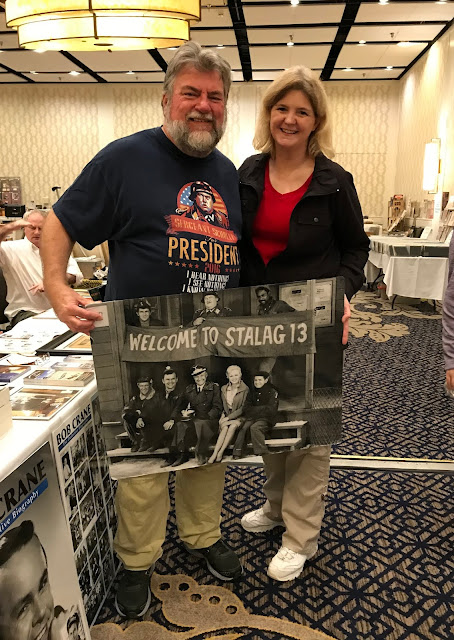
Carol Ford with long-time friend Brian Dettling.
Carol Ford with friend and vendor neighbor Mark Redfield.
Learn more about Mark's work by visiting his website (click here).