Showing posts with label Classic TV. Show all posts

Wednesday, June 29, 2016

Remember Bob Crane Not for His Murder, but for the Joy He Gave the World


Today, June 29, is a sad anniversary: the day we lost Bob Crane in 1978. But let's not dwell on the negative. I don't believe for an instant that Bob would want us to be sad. So let's instead remember him for all the good he did in life and the joy he brought to millions on Hogan's Heroes, radio, his drumming, and through his charity work! There was a whole lot of good there! 


Tuesday, June 28, 2016

On the Eve of a Sad Anniversary, a Bright Moment

Every year, on June 28, I think of Bob Crane's last day on earth. It's not a day I enjoy, and neither is tomorrow, when "This Day in History" trivia headlines will scream the words murder, sex, and scandal along with his name. But Bob had a full life ahead of him, one that included watching his children grow up and become successful, and one that included bettering his own life and moving forward in his career by breaking out of his typecasting as Colonel Hogan and taking on more dramatic roles.

But he would never get that chance. The sun set on June 28, 1978, and Bob would never see daylight again. A bright future was snuffed out.

For Bob's family, friends, colleagues, and scores of fans, June 29th is a sad anniversary. Bob Crane should never have been murdered. 

This year, however, thanks to Gery L. Deer, a journalist in Ohio who stopped by the Liberty Aviation Museum for my author event and unveiling of the museum's Hogan's Heroes artifact collection, there is a bright and shiny spot amidst the darkness.

Watch the video below, and then—share it. Help offset the negative by shining a new light on Bob Crane, a man described repeatedly by those who knew him as a ray of light with a sunny personality who routinely looked on the bright side of life.

Note: Remember, our author profits on sales of Bob Crane: The Definitive Biography are being donated to various charities and organizations in Bob's memory.


Monday, June 27, 2016

A Phenomenal, Whirlwind Weekend: Barnes & Noble Author Events — Waterbury and Stamford, CT

Barnes & Noble, Waterbury, Connecticut
June 25, 2016.


People who know me know that when it comes to Bob Crane, I can become overwhelmed with emotion pretty quickly. Emotions run the gamut: pure joy and elation when I see the public's opinion change from negative to positive right before my eyes; excitement and anticipation about my next author event; innocent happiness when I watch Hogan's Heroes or listen to any of his radio airchecks; sadness and helplessness over how his life was snatched away by the cruel hands of another; frustration that he never got to live long enough to realize any life goals past forty-nine years of age; and hot anger when the media chooses to spend its time fixated on sex and murder, especially when we know there was so much more to who he was as a complete human being.

Dee Young (left) and Carol Ford
Barnes & Noble, Waterbury, Connecticut

June 25, 2016.
When I travel around the country to author events,  I'm happily amazed at how quickly people switch their opinion about Bob from negative to positive. For so long, they have been force-fed hype and incorrect information, but doesn't necessarily mean that they wanted it. In fact, what I'm discovering is that despite the media's attempt to fool their audience by highlighting only sordid details (and more often than not, without proper context), what people really want and prefer is the truth. And in Bob's case, the truth is overwhelmingly positive. I can't tell you how many times I have seen good people nod their heads in agreement about how the media often gets it completely wrong. It doesn't surprise them that the media have a penchant for chiseling down a person's life story to shock and awe, and not much else. They have always liked Bob Crane, they tell me. They always suspected there was more to him, they admit. Time and again, they thank me for all of our hard work in getting the truth about Bob out there. Sometimes, they come up to me in tears, which affects me on a very profound level.

Most people really do care about Bob Crane; they just have not been given the chance to for fear of being ridiculed right along with him. That is, until now. This is the complete opposite of what one network representative told me last year, in person. "Your book will never sell," he said. "People don't want nice. They want scandal. That's what we give them because that's where the money is."

It's a long, difficult road, but one day at a time, and one person at a time, we are proving that representative wrong.

This weekend, my one co-author Dee Young and I did two back-to-back author events in Connecticut: the first in Waterbury, where Bob was born and where members of his extended family still reside; and Stamford; where Bob grew up; graduated from high school; spent two years in the United States National Guard; married his high school sweetheart; worked as a watch repairman at a jewelry store; dreamed of working in radio and began constructing amateur programs for his friends; and spent his free time performing as the drummer in his jazz band. More than half of Bob's life was lived in Connecticut, and despite his many successes and fame, he always called Connecticut home. He never forgot his roots.

When I go to author events, I don't just show up and sit at a table with a stack of books. I bring a full display, one that includes screen-used Hogan's Heroes props, autographed photos, poster boards containing rare photographs from Bob's entire life, his high school yearbook, and much more. I want people to enjoy the event, not just smile cordially at me as they walk past to the "New in Fiction" table or magazine rack. For many, Hogan's Heroes brings back fond childhood or early adulthood memories, and I want their visit to the bookstore that day to be fun and memorable, as well as educational.

Dee Young (left0 and Carol Ford
Barnes & Noble, Stamford, Connecticut

June 26, 2016.
Both the Waterbury and Stamford signings were a terrific success! In both stores, several people who knew or were connected to Bob stopped in to see us: a member of Bob's family; a radio enthusiast who has been a strong advocate of our efforts for years; a gentleman who worked with Bob at WBIS in Bristol, CT, in 1951; the brother of one of his close childhood friends; one of his dearest friends from high school; the contact from Stamford High School who met with me back in 2006—and allowed me to have a copy of the Class of 1946 yearbook; and the daughter-in-law of Bob's best friend from high school. It made me so incredibly happy to see all of them and for them to see our efforts finally realized and successful. Other shoppers from the area were surprised to learn that "Colonel Hogan" was born in Waterbury and hailed from Stamford, and they loved discovering his real story. And that makes my heart so happy and enlightens my spirit.

Bob Crane: The Definitive Biography author event.
Barnes & Noble, Stamford, Connecticut / 
June 26, 2016.
Photo courtesy of Barnes & Noble, Stamford.
This was, without question, an amazing weekend. Being with members of Bob's family in Waterbury and getting to spend time with them touched my heart deeply, and being with some of the people who loved him as a friend and colleague made me overjoyed. I get overwhelmed (in a good way), but days like these are truly life-changing. These beautiful people who loved Bob (and still love him) mean so much to me, and they stay with me. Near or far, they become part of my own life story, and it's something I cherish on a daily basis. Bob surrounded himself with some of the most radiant and gracious individuals I have ever had the honor and pleasure to know, and they mean the world to me. Seeing their joy and happiness because of all the positive energy coming from this book and our hard work humbles me beyond measure.

Researching, writing, and publishing Bob Crane: The Definitive Biography was a daunting task and a labor of love; and marketing and promoting the book, while fun, is time-consuming, expensive, and often very exhausting—physically and emotionally.

But every single bit of it is all worth it. 

~~~~

Big thank you to the Barnes & Noble stores in Waterbury and Stamford, Connecticut, for hosting our author events! Special thanks to Robin Masiewicz, Assistant Store Manager  (Waterbury location), and Kai Connolly-Raub, Community Business Development Manager (Stamford location), as well as the friendly and helpful staff at each store. Dee and I appreciate all your hard work in preparing for and running the events, and for caring so much about Bob Crane and his true story!

Sunday, April 24, 2016

Twenty Things You Didn’t Know about 'Hogan's Heroes' Star Bob Crane

Everybody has a history to his or her life.
Let’s not paint Bob’s life by—what shall we say?—the moments in his life.
I say these things that are the flaws are like specks on the Parthenon.
Let’s look at the Parthenon and let’s not look at the specks.
Let’s lift our eyes up to the man’s eyes and soul and life, and not look
down on the gutter.
—Joe Cosgrove, former staff announcer, KPOL, Los Angeles, and owner, KTHL, Lake Tahoe, CA; the first person to greet Bob when he arrived in Hollywood in August 1956.
©2015 Carol M. Ford, Dee Young, & Linda J. Groundwater
~~~

When you spend decades researching something or somebody, you are going to learn a lot.

Such is the case with Bob Crane. After decades of research, my colleagues and I uncovered so much new and noteworthy information about Bob, we were, in a word, amazed. Bob Crane: The Definitive Biography is more than 600 pages in length because there was just so much to tell. And there was also so much to fix. Over the years, the facts about Bob's life have been twisted around and exaggerated, or worse, fabricated. These inaccuracies had to be corrected and then retold properly or debunked completely.

I've compiled a list of important facts about Bob here, with details contained in Bob Crane: The Definitive Biography. Some people are afraid of what they might find in the book because Bob's reputation precedes him. But rest assured, the general public has not been given the whole story or even the true story. After reading through this chiseled-down list of facts, please check out Bob Crane: The Definitive Biography. It will change the way you think about Bob Crane, and I think you will be happily surprised.
~~~

1. Bob Crane was born in Waterbury, CT, on July 13, 1928. He grew up in Stamford, CT, and graduated from Stamford High School in 1946. He was one of the most popular kids in school.

2. Bob was inspired to play drums by watching Gene Krupa at the 1939 World’s Fair. From that time on, he was never without his drumsticks. He played drums throughout his life.

3. Bob’s older brother Alfred served in the U.S. Navy during World War II. Al was badly injured during the war but survived. Al’s wartime experiences had a dramatic and lasting impact on Bob.

4. Following high school graduation, Bob served in the U.S. National Guard in Stamford, CT, and worked in a jewelry store.

5. Bob played with many name bands on the East Coast while working in radio. He was eventually able to sit in and play with his idols, including The Stan Kenton Orchestra, the New Tommy Dorsey Band, and the Harry James Orchestra. He performed a drum battle with Gene Krupa over KNX-CBS Radio. He was a good friend of Buddy Rich, and he would occasionally perform with Rich in various venues, such as at Disneyland.


6. Bob spent fifteen consecutive years in radio, transforming the industry, and was considered a radio genius by his broadcasting colleagues. His radio show was so successful that by the time he was working at KNX in Hollywood, there was a premium for advertisers to buy time during his program, and they had to buy other time slots in addition to Bob's. In addition to doing things in radio that had rarely, if ever, been done before, Bob was also a gifted voice impersonator. KNX dubbed him radio’s Man of a Thousand Voices.

7. Bob interviewed thousands of celebrities on his KNX radio show, including Marilyn Monroe, Jack Lemmon, Ronald Reagan, Jonathan Winters, Dick Clark, Jayne Mansfield, Ron Howard, Jerry Lewis, Richard Dawson, Carl Reiner, Dick Van Dyke, Mary Tyler Moore, and more. Because he wanted to act, he turned down countless offers to transition his radio show to television, including to take over as host for The Tonight Show. It then went to Johnny Carson.

8. In 1964, Bob took an acting course taught by Stella Adler. He also took acting advice from Donna Reed during at least the first season of Hogan’s Heroes.

9. Bob left The Donna Reed Show because he was bored with the premise. He remained friends with Donna Reed and her producer/husband Tony Owen following his departure from her series.

10. Bob was a great supporter of U.S. veterans and active duty service personnel. Before accepting the role of Colonel Hogan on Hogan’s Heroes, Bob insisted that a trailer of the series be shown to veterans and former POWs. He wanted to be sure they approved of the premise before signing because he didn’t want to offend them. They loved Hogan’s Heroes, claiming without humor, they never would have made it through the war. Bob was sold, and the rest was history.

11. Before agreeing to star on Hogan’s Heroes, Bob was inundated with offers for the lead in many other series, including Please Don’t Eat the Daisies and My Mother the Car.

12. Bob got his acting start in 1959 in a community theatre production of Tunnel of Love. He performed in theatre throughout much of his life, even during the height of his career on Hogan’s Heroes. He received rave critical reviews for nearly every one of his theatre productions. 

13. After being cast as the lead in The Wicked Dreams of Paula Schultz, Bob urged director George Marshall to hire as many cast members from Hogan’s Heroes as he could so they would have work during their hiatus. Those who accepted roles in the film included Werner Klemperer, John Banner, and Leon Askin.

14. Bob wrote an ending to Hogan’s Heroes, entitled Hogan’s Heroes Revue, which was a variety act to have been performed in Las Vegas. Robert Clary and Werner Klemperer were signed on to star with him in the live show, as well as John Thompson, Bob’s close friend and a magician who today is the magic consultant to Penn & Teller and Criss Angel, among others. Hogan’s Heroes Revue was never produced because Bob did not agree with what he considered a dishonest business contract with the casino.

15. During the 1970s, Bob turned down many offers to star in television shows and emcee game shows and talk shows. Instead, he accepted the leading role in Second Start, which was retitled The Bob Crane Show. He also co-wrote Mobile Two, the pilot movie for the series Mobile One, starring Jackie Cooper. 

16. When Bob breaks down in tears on his episode of The Love Boat, he is acting. It was not an indication of his state of mind at the time. In between takes, he was friendly, affable, and got along well with the cast. This performance shows how Bob was evolving as an actor, not as someone who couldn't hold it together at work. He was planning on taking on more serious roles such as his character on The Love Boat, but he didn't have the chance because he was murdered.

17. Bob Crane did not exhibit any inappropriate behavior on Celebrity Cooks. That he did is completely false, a story fabricated for ratings and profit. Celebrity Cooks has officially gone on record to dispute any claims that Bob behaved inappropriately in the episode. They state Bob was one of their best guests, and the way his episode is depicted in Auto Focus is totally incorrect and never happened.

18. Bob was a selfless philanthropist who gave generously of his time and money to many different charities, and he receives very little recognition for it. These included: U.S. Armed Forces Radio Network, United Cerebral Palsy, the Arthritis Foundation, and Operation Entertainment, to name a few. He also met regularly with U.S. veterans groups and entertained at military bases across the country.

19. At the time of his murder on June 29, 1978, Bob had a new television series in the works and was focused on bettering his life and overcoming his addiction. NOTE: Bob Crane is only "guilty" of consensual sex with adult women, whom he occasionally photographed or video recorded. Keep in mind the key words here are consensual and adult. And yes, the women knew they were being photographed and/or filmed. This was investigated by authorities following Bob's murder and proven as fact.

20. Bob loved and adored his family and friends, and especially his children. His legacy lives on through all of them. In 2013, his grandson, Max William Crane, made his acting debut in Fast & Furious 6 as little baby Jack.

~~~


Tuesday, March 8, 2016

Book Signing Set for Bob Crane's Biography at Liberty Aviation Museum/Port Clinton, Ohio


Bob Crane: The Definitive Biography Book Signing with author Carol Ford
Dates: June 11 & 12, 2016
Location: Liberty Aviation Museum
Times: TBA
Carol will have a Q & A in addition to the book signing covering Bob Crane’s life & his role in the TV show, Hogan's Heroes. The museum's display of Hogan's Heroes uniforms are currently on display within the museum and will be on display during the book signing.
To learn more about the book, Bob Crane, or the author Carol Ford, please visit http://www.vote4bobcrane.org/book.html

~~~~~

I am honored and delighted to announce that I will be visiting the Liberty Aviation Museum on Saturday and Sunday, June 11-12, 2016, for a book signing of Bob Crane: The Definitive Biography.

You may remember that in September, the Liberty Aviation Museum acquired Colonel Hogan's leather A-2 bomber jacket,  owned by Bob Crane and worn throughout the run of Hogan's Heroes, as well as worn by Frank Sinatra in Von Ryan's Express. The museum also acquired Colonel Klink's uniform and Sergeant Schultz's overcoat. The Hogan's Heroes exhibit is growing, and as more original props and show memorabilia are acquired/donated, the goal is to make this the official Hogan's Heroes exhibit. The current display is temporary, with a much larger display being constructed in the museum.

In addition to preserving these iconic pieces of television history, the Liberty Aviation Museum has also been a loyal supporter of Bob Crane: The Definitive Biography and all of our efforts to see Bob Craned recognized properly. If you are in the Port Clinton, Ohio, area or can make the trip from afar, I hope you plan to join us in June for my book signing and to view the Hogan's Heroes display. 

Special note: My author profits from this signing will be donated to the Liberty Aviation Museum, whose mission is "to provide an adequate organization for historians, aircraft and vehicle preservationists and collectors interested in encouraging internationally the acquisition, restoration, operation, preservation, public education and display of historic aircraft, vehicles and related items." Through their efforts, the Liberty Aviation Museum is able to help and support our American veterans and active duty members serving in the United States Armed Forces. 

Friday, February 26, 2016

Quote of the Day: Bob Crane about His Role on 'Hogan's Heroes'

I am keeping a running page of quotes by Bob Crane (click here or on the photograph below), but I have also decided to post some of the individually as well. The following is one of my favorite statements Bob made about his role as Colonel Hogan on Hogan's Heroes. Bob was used to performing comedy, but in the case of Hogan's Heroes, he was what is considered the "straight man," or the person from which all of the comedy bounces. The early episodes of Hogan's Heroes provide a glimpse of how Bob started out as more campy and more of the comedian, but then quickly toned that down to be more serious, allowing the comedy happening around him to succeed. Comedy is about timing, and Bob's portrayal of Hogan is perfection. And as someone who has loved Hogan's Heroes from the first day I discovered it, I adore the idea of Colonel Hogan being seen as a father figure to his men! 


Monday, February 8, 2016

Thanks to Barnes & Noble, Deptford, NJ, for a Terrific Author Event!

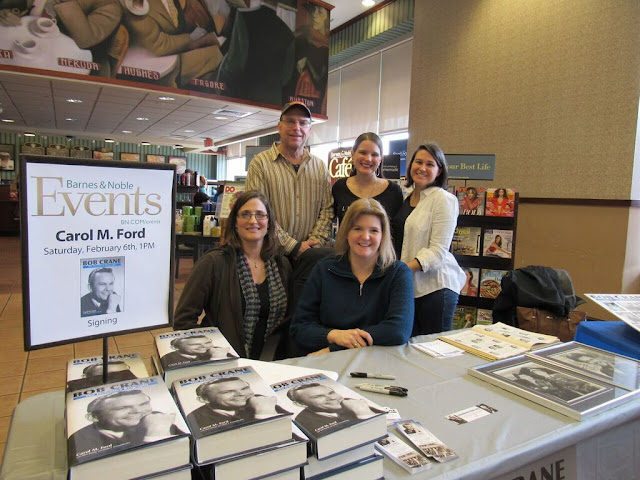
On Saturday, February 6, 2016, I had the honor of being the featured author at the Barnes & Noble Bookstore in Deptford, New Jersey, for a book signing of Bob Crane: The Definitive Biography. The event was a huge success, and I want to thank the managers and staff at Barnes & Noble, Deptford, for their kind hospitality throughout the day. And I also want to give a big thank you to my family and some dear friends for coming to the book signing! (If you couldn't make it over, I know you were there in spirit!)

New author events are in the works, so keep checking back here and on our social media sites for dates and locations!


Wednesday, January 20, 2016

Bob Crane Biography Book Signing / February 6, 2016 / Barnes & Noble, Deptford, NJ

Beginning at 1:00 p.m. on February 6, 2016, I will be available at the Barnes & Noble bookstore in Deptford, New Jersey, to sign copies of Bob Crane: The Definitive Biography and answer any questions you may have. The winter weather can be a gamble in the Northeast, but I'm hoping that the snowstorm that clobbers us this weekend will satisfy Mother Nature until after my author event. Should there be inclement weather, however, I'll update this post and advise everyone on all of my social media sites. I'm looking forward to yet another fun and successful time meeting people and fans of Bob Crane and Hogan's Heroes! Hope to see you there!


Tuesday, January 19, 2016

Excerpts from 'Bob Crane: The Definitive Biography' (Chapter 1)

Bob Crane was a fascinating, kind, gentle, caring, and generous person. He was not without faults, but then, the same is true for all of us. That his addiction and murder are continually scrutinized, to the exclusion of nearly all else, is wrong and just plain sad to me. There is a lot more to his story—660 pages worth!

More than anything, I want you to discover who Bob Crane was as a person. It's so important to understand that he was so much more than Colonel Hogan, should never be defined by his sexual addiction, and was not just a murder victim. He was a son, a husband, a father, a cousin, a friend, a coworker. He was a human being. And he was a good human being at that.

I want you to read Bob Crane: The Definitive Biography so badly, but not because I want to get rich off of it. 

All author profits are being donated to charity in Bob Crane's memory.

That is how much this book—and Bob's life—mean to me, my two co-authors, Bob's family, his friends, and all who loved him and cared about him. It's not about the money. It's about the truth. Bob deserves better, much better, than what has been dished out about him since his death.

So I will give you some excerpts over the next few weeks, chapter by chapter, from Bob Crane: The Definitive Biography. All I ask is that you allow yourself the chance to discover and learn. 

~~~~~

The following excerpt is from "Chapter 1: The Spirit of Stamford"
Alfred John Crane (Al, Jr.) was Bob's older brother. Charlie Zito was Bob's best friend from school. Don (Sappern) was also a close high school friend who played in the jazz band with Bob.

World War II was at its peak when Bob was in high school. There was food rationing. No more than two pounds of meat per family. Butter was unheard of. Sugar from Cuba had been cut off for fear of the trade ships being sunk. Three and a half gallons of gasoline per week were permitted unless it was to be used for something pertaining to one’s job. The war affected every part of life. For many, it meant enlisting in a branch of the service and going “over there” to fight. For those who stayed on the homefront, it meant volunteering and sacrificing—doing any and all that could be done to support the United States Armed Forces and help the Allies win the war.

At night, windows were heavily draped, with no lights showing through. During air raid drills, Charlie Zito’s father, an air raid warden, went around to different neighborhoods ensuring lights were out. With the city of Stamford blacked out, Bob’s father would go to the rooftop of Stamford High School, where he and other volunteers would watch the night sky for enemy aircraft. If an enemy plane was suspected, it was reported.

Kids in school during that time had more of a “superman” approach to the war. Charlie explained, “You never really thought about dying at that age. If somebody was going to die, it wasn’t going to be us.”

Nevertheless, it was a very serious time for high school students. Gym class consisted of commando training, push-ups, and according to Charlie, “other more strenuous forms of torture.”

“We didn’t have gym,” Charlie recalled. “We went outside with gym shorts on—ice, snow, mud, whatever—and did calisthenics and ran around the track. They had somebody teaching us hand-to-hand combat. They really were trying to toughen us up.” 

Families with sons serving overseas on the front lines posted little flags in the shape of a pennant upside down in their windows. If you had one son in the service, you had one pennant or star. Some families had three sons in the service, so there would be three flags. If you lost a son, it was etched in black. Bob’s family displayed such a flag, and it came very close to being etched in black.

In August 1943, when Bob was fifteen years old, Al, Jr. joined the Navy, and on August 11, 1944, he reported for duty on the USS Bunker Hill (CV-17) aircraft carrier. The Bunker Hill saw action in the Pacific Theater, and Al saw at least four major engagements while serving on duty. Al was on board on the morning of May 11, 1945, just three days shy of his nineteenth birthday. While supporting the Okinawa invasion, the carrier was attacked by two kamikazes, severely damaging the ship. Her losses included three hundred forty-six men killed, forty-three missing, and two hundred sixty-four wounded.

When it was learned that the ship had been attacked and badly crippled, the Crane household went into turmoil. “The waiting and the waiting and the waiting,” Charlie recalled. “Wondering did Al survive? It was just terrible.”

Communications in 1945 were not as they are today, and nearly three weeks passed before word arrived about Al’s fate. During those weeks of not knowing, which Charlie said seemed like an eternity, Bob would go to Charlie’s house often.

Bob was devastated by the possibility that his brother might have been killed. He held it together most of the time, but when he was with his closest confidants, he would let his true feelings show.

“I’ll tell you,” Charlie said, “if you really got into it with him, and I didn’t like to do that too much—I didn’t want to see Bob that way—he would be brought to tears. And so consequentially, when it got to that point, I would change the subject. And then he caught on, and then he would change the subject, and we’d forget about it for awhile. It just wasn’t the same. He didn’t want to upset his parents. He didn’t want his parents to think he was still going on with his life and having all the fun he was having at the time. He thought maybe they would get the wrong impression. He used to bring a drum with him, and he’d play, and I’d play piano, and we’d listen to some of my records. But it wasn’t the same.”

Al survived the attack, but not without physical and psychological injury. Seeking an escape out of the burning hull, he climbed up a red-hot chain out of the fire to the ship’s surface, and he was badly wounded. Later, he learned that his shipmate who had relieved him of his radio post shortly before the attack occurred was killed in the attack. While Al had been very proud to serve in the war and on the Bunker Hill, he would carry these scars of guilt with him for the rest of his life.

When word reached Stamford that Al was alive, “it was like Christmas,” Charlie recalled. “It had been sad, especially the not knowing. Every time you’d see it—what we used to do to have fun, it was always in the background. There was a war on. Your neighbors were being killed. Brothers were being killed. And not knowing for a long time that Bob’s brother did survive was horrible.”

The school was preparing to graduate Bob, Charlie, Don, and many of their classmates and friends early so they could enter the war. Their report date was to have been May 20, 1945. With Victory in Europe (VE) Day occurring only a few days prior, on May 8, 1945, they just missed their draft date by a mere fraction. Their parents breathed a sigh of relief, and instead of going off to fight a war, their kids continued on with school.

Bob Crane: The Definitive Biography
© 2015 Carol M. Ford
Do not reproduce without written permission from the author.
Saturday, January 9, 2016

Rod Serling Hated 'Hogan's Heroes' — And That's Okay!

My mother hates Hogan's Heroes.

Yes, that's right. The woman who gave birth to the author who would one day write and publish a 660-page tome about the show's star despises the series that gave the world Colonel Hogan and made Bob Crane an international celebrity. Yikes!

My mom and I have a healthy, loving, mother-daughter relationship. She is the backbone of the entire family, and she supports my sister and me in all we do. She also likes Bob Crane as a radio personality and as an actor in general. And through the work of her rather determined and somewhat tenacious daughter, she has come to understand Bob Crane on a truer, more human level.

But Mom just never liked Hogan's Heroes. And for that matter, she never liked M*A*S*H or Doctor Who, but she can binge-watch NCIS and the Hallmark Channel's Christmas movies like it's nobody's business.

And so it goes. We all like and dislike certain things in the world. That's what makes us unique. If we want people to respect us for what we like, then the opposite must hold true. And if we dislike a certain television show or movie, it does not necessarily mean we hate the actors appearing in it. In most instances, we just don't care for the plot.

Recently, a Twitter discussion ensued about Rod Serling, the creative genius behind The Twilight Zone, and his abhorrence of Hogan's Heroes. His disgust of the series was so profound that his daughter, Anne Serling, felt compelled to include it in her highly acclaimed memoir, As I Knew Him: My Dad, Rod Serling.

Serling's daughter doesn't hold back when she talks about her father's hatred of Hogan, Klink, and Schultz, and their World War II German POW camp antics. She writes:

One program, though, that we are never allowed to watch is Hogan's Heroes, about a Nazi prisoner-of-war camp. My father has a particular abhorrence of this show and no tolerance for how it perversely twists what happened in Nazi prison camps into something remotely comical. Years later, in a speech at the Library of Congress in Washington, it is clearly still on his mind.
'You take a show like Hogan's Heroes. Now, here you have a weekly, mirth-filled half hour that shows what a swinging ball it must have been in a Nazi POW camp. Now, there's a slight deviation from the norm in that there are good guys on this show; certainly, but there are no bad guys, at least not in the sense that we're used to recognizing our enemies as they appeared in old Warner Brothers films... 
'Now through the good offices of Hogan's Heroes, we meet the new post-war version of the wartime Nazi: a thick, bumbling fathead whose crime, singularly, is stupidity—nothing more. He's kind of a lovable, affable, benign Herman Goering. Now this may appeal to some students of comedy who refuse to let history get in the way of their laughter. But what it does to history is to distort, and what it does to a recollection of horror that is an ugly matter of record is absolutely inexcusable. Satire is one thing, because it bleeds, and it comments as it evokes laughter. But a rank diminishment of what was once an era of appalling human suffering, I don't believe, is proper material for comedy.'
He goes on to suggest that the success of Hogan's Heroes could lead to The Merry Men of Auschwitz, or Milton Berle in a new musical version of the Death March on Bataan, or a singular shot spectacular, The Wit and Wisdom of Adolph Hitler (pp. 133-134).

There is little doubt that Rod Serling loathed Hogan's Heroes. His words are harsh, and they cut to the quick. Any fan of Hogan's Heroes (and I'm one of them!) would leap to the show's defense. Robert Clary, who is Jewish, spent two years in concentration camps and lost many of his family members to the Nazis. Yet he wasn't offended by Hogan's Heroes and enjoyed portraying his character Corporal Louis LeBeau. Other series stars who were Jewish (or of Jewish heritage) include Werner Klemperer, John Banner, Leon Askin, and Howard Caine. Cynthia Lynn and her mother and grandmother survived German-occupied Latvia. John Banner is quoted as saying Schultz is, in fact, not stupid: "Notice that he survives." And Werner Klemperer agreed to play the role of Colonel Klink only if Klink were always made out to be the fool.

Bob Crane's brother almost died serving in the U.S. Navy during World War II (he was badly injured), so before Bob even considered signing the contract to play Colonel Hogan, he insisted that the producers show veterans and former POWs an early trailer to be sure they were not offended by the series. They loved it, saying without humor, they never would have made it through the war. Bob also spent a great deal of time defending the plot of Hogan's Heroes, saying it was not about making the Germans look foolish. Klink and Schultz are the buffoons, but the Nazis that visited the camp from Berlin had to be convincing as bad guys. He also defined it as a show that was a mock of authority, and according to his fan mail, people loved it when he gave it to Klink because they could relate: it was like giving it to the boss.

For Bob Crane: The Definitive BiographyHogan's Heroes director Robert Butler explained to Linda Groundwater and me that the backdrop of war was a crucial element in the success of a show. It just "works." The drama is heightened because any one of the good guys could "get drilled" at any time. He said you do "moments," where the viewer is given a taste of that wartime tension before the comic relief. 

An example of one of those "moments" comes from a fan favorite, "Will the Real Adolph Please Stand Up," where Sergeant Andrew Carter (Larry Hovis) impersonates Hitler for the first time (and really convincingly, I might add!). Carter stumbles onto his uncanny ability to impersonate Hitler rather innocently, and he makes the mistake of doing his Adolph schtick in front of his commanding officer, Colonel Hogan. And Hogan really lets him have it. 

This is what separates silly nonsense from smart comedy. Realism. There is no way Stalag 13 could have existed in real life, but the tension of war did. And Bob Crane and his fellow cast members capture that tension regularly throughout the run of the series. Hogan's Heroes was not allowed to grow, however, in the same way that M*A*S*H eventually did. It always stayed in the same formula week after week, and part of that is the era in which it was produced. 

But I can talk until I'm blue in the face. There will always be those people who just don't like Hogan's Heroes. They, including my Mom and Rod Serling, can't get past the horrors of war and the atrocities caused by the Nazis.

And that's okay.

In fact, it's more than okay. To each his own. What would we talk about if we were all exactly the same and liked all the same things?

All of this aside, what should not be confused is how Rod Serling felt about Bob Crane. Just because Serling hated Hogan's Heroes does not mean he hated Bob. He held absolutely no personal animosity toward Bob despite his utter dislike of Bob's star vehicle.

The truth is—Rod Serling did like Bob Crane. He simply disliked a television series. It could have been anybody in the title role of Colonel Hogan. Serling would have hated the series just the same. While it's a safe bet that Serling would have preferred it if Bob had declined the role of Hogan, his hatred of Hogan's Heroes was not a personal attack on his friend and colleague.

Bob Crane and Rod Serling enjoyed a long professional relationship over the years. Serling was a frequent guest on Bob's KNX radio program. Ironically, in the clip below (which aired live on December 11, 1961), they discuss those people who hate The Twilight Zone (in this case, the episode "The Shelter") and those who write compulsively to Serling to tell him about it. Serling's response is to quote the 1st Amendment, stating that there should be no abridging the freedom of speech or of the press. Regarding his hate mail, Serling says, "I'm delighted. Let them write anything they want. I don't think we're in trouble in this country if we let people say, talk, think, comment. This isn't our problem. It's when we start to abridge that."


In November 1960, Bob got his first major break in television. Rod Serling hired him to play the uncredited radio announcer in The Twilight Zone episode, "Static." Bob was known as radio's Man of 1,000 Voices, and he performs all of the voices heard on the radio in this episode. The episode taped on November 20, 1960, and Bob was paid $155.00 for his voice over work "of more than five lines" in the episode. "Static" aired on March 10, 1961.


During Bob's post-Hogan's Heroes days, Serling hired Bob to perform several times in his Zero Hour radio mystery series. And Bob also guest-starred on Serling's television series Night Gallery in the episode "House with Ghost" (also with co-star and friend Bernard Fox). Further, Bob's daughter, Karen Crane, grew up with Anne Serling, and the two remain friends to this day.

When all is said and done, Rod Serling simply didn't like Hogan's Heroes and wanted to let people know. He expressed himself constructively and without personally attacking any one individual, from Bob Crane to anyone connected with the series. I see Hogan's Heroes differently, as did Bob and many others. But I respect Serling's feelings and those of others who dislike the very program that I describe as brilliant and one of my all-time favorites. 

It's not the the end of the world if we are different from one another and have varying opinions. That's what makes life fun! We're only in trouble if, as Serling states, we start to abridge that diversity.

Sunday, January 3, 2016

Bob Crane and John Banner Appear on 'The John Gary Show'—June 29, 1966

On Wednesday, June 29, 1966, Bob Crane made a guest appearance on The John Gary Show. Joining him were his Hogan's Heroes co-star John Banner, Vicki Carr, and Roger Williams. Similar to other programs of the era, The John Gary Show was a variety show and featured a lot of singing, dancing, skits, and of course, in this episode, Bob's drumming.

As a radio personality at KNX from 1956 to 1965, Bob interviewed thousands of celebrities, and in the early 1960s, John Gary was a guest on his show. Bob actually had two celebrity guests on the air that day—John Gary and Richard Chamberlain. Those who were present claimed that both were wonderful guests and that John Gary was "very sweet and so nice." Bob and his two guests had a great time on the air, and even encountered an awkward moment when he and Richard Chamberlain called the winner of a hi-fi stereo system, and took the winner completely by surprise! There is little doubt that John's experiences on Bob's KNX radio show led to him asking Bob to appear on his own program a few years later while Bob was on hiatus from Hogan's Heroes.

Bob loved music in general, and in addition to his drums, he loved to sing. During his early school days, he would walk to school with his friends, singing away and teaching his pals the lyrics of the day. But we never got to hear much of his singing on Hogan's Heroes or other works (with the exception of him singing along with songs on his radio shows, or on programs such as The Smothers Brothers Comedy Hour and The Hollywood Palace). But here, on The John Gary Show, Bob sings along with John Banner, "What Would You Do Without Me?"—and the two of them performing the number dressed in their Hogan's outfits is adorable and priceless! This episode is no longer available on YouTube, but scroll down to the bottom of this post for ordering information directly from John Gary's estate.

~~~~~


~~~~~

I'm happy to say that this episode is available for sale through John Gary's estate/website. If you're a Hogan's Heroes and Bob Crane fan, you won't be disappointed! Click the image below to be redirected to their website and order your own copy!
Be sure to check out their other items as well.


Wednesday, December 23, 2015

2015: Wow, What a Year, with More in Store for 2016!

A few friends stopped in during my book signing
for Bob Crane: The Definitive Biography
at Bogart's Bookstore and Cafe
in Millville, New Jersey. I love this place!

On Friday evening, December 18, 2015, I enjoyed a night of book signing, music, and conversation at Bogart's Bookstore & Cafe in Millville, New Jersey. This was the latest in a string of book signing events I have done since Bob Crane: The Definitive Biography was published in September, and I have to say, I'm hooked! I love every second of it! There is nothing I love more than meeting people who like and appreciate Bob Crane, or who didn't know a whole lot about him before talking with me and who walk away with a more profound understanding of who he was as a person. 

Whether it was during a presentation before a large audience at the Mid-Atlantic Nostalgia Convention in Hunt Valley, Maryland, or casual conversations with curious shoppers at independent bookstores, one by one, people are starting to learn about Bob Crane. He was more than Colonel Hogan on Hogan's Heroes, more than a murder victim, and more than a means to a profit via scandal and sensationalism. He was human—and a good human at that. 

By far, my favorite moments are when people approach me with pre-conceived notions about Bob because of what they have already seen in the media but who change their opinion after meeting me. Initially, they use words like "creep," "pervert," "deviant," and "sick-o" to describe Bob, only to discover they have been misinformed. One lady came up to my table on Friday night and said, "Oh, that guy. I know all about him." After a few minutes of talking with me, however, her demeanor changed. Before she left, she said, "Thank you. I'm so happy and relieved to know he wasn't a jerk! I always liked him on Hogan's Heroes. This makes me feel so much better!"

Other favorite moments include learning that people have driven great distances to meet and talk with me. At the Nostalgia Convention in Maryland, one person drove all the way from Texas, and on Friday night, a gentleman and his wife drove up from Delaware. I'm completely humbled and touched by their gestures, and I only wish I had more time to talk with them! 

What I'm discovering is what my gut has always told me: people want to like Bob Crane. They just want to be reassured. I know because before I wrote this book, I was one of them. They loved him on Hogan's Heroes. Those who were lucky enough to hear his radio programs on both the East and West coasts loved hearing his shows. But since his murder and the sex scandal that followed, many have been unsure of what to think of their favorite POW or radio personality, especially when all the media has ever seemed to focus on were his murder and sex scandal. Bob Crane: The Definitive Biography is different from anything else that has ever been done for him. It puts everything in context, presents the facts, and dispels the myths. It's okay for people to like Bob Crane again! And for those who have read the book and/or talked with me, their outpouring of gratitude—and often with emotion—speaks volumes.

As we close out 2015, I am happy to say this has been a tremendous year for me. The first half was spent finishing writing and formatting, and the second half was spent promoting the book and enjoying its success. After production and publishing expenses are paid off, author profits will go to various charities in Bob Crane's memory. The reason for publishing this book was never to get rich; it was to simply do Bob justice by telling his true story.

As we move into 2016, more book signings/author appearances will be announced (save the date: February 6, 2016, I'll be at the Barnes & Noble in Deptford, New Jersey). I'm trying to work out some appearances in the Midwest and in Los Angeles, and I'll keep you posted as those develop. More radio interviews will be conducted. And of course, we will keep up our ongoing efforts for Bob's induction into the National Radio Hall of Fame. The year 2015 was a remarkable year for me, and I anticipate 2016 will be just as exciting and rewarding. Thank you to every single one of you who has supported and helped along the way! 

Stay tuned—more good things are on the horizon!

Happy Holidays!

Monday, December 21, 2015

The Donna Reed Show — 'A Very Merry Christmas!'

Note: In March 1963, Bob Crane made his first appearance on The Donna Reed Show as Dr. Dave Blevins. This one guest appearance led to his being cast in the semi-regular role of next-door neighbor Dr. Dave Kelsey, officially launching his acting career and preparing him for the future. Bob thought highly of Donna Reed, who often coached him as an actor and offered him advice during Hogan’s Heroes. When asked about what he thought of Donna, he said, “She was marvelous. I learned everything I know in the business from her.” (For more about Bob Crane’s role on The Donna Reed Show, click here.) Although Bob did not appear in the Christmas episode, we have chosen to take this opportunity to honor The Donna Reed Show with a post about her holiday episode, "A Very Merry Christmas," as part of Me-TV's "A Very Merry Blogathon," hosted by the Classic TV Blog Association. This post is written by guest author Jude H. Cormier, owner and manager of the We Love The Donna Reed Show Facebook page. Thank you, Jude, and Happy Holidays to all!

~~~~~~~~~~~~~~~~~~~~~~~~~~~~~

The Donna Reed Show — 'A Very Merry Christmas!'


by Jude H. Cormier

When one thinks of the Christmas holiday, especially the televised version of it, you have the expected pitfalls and trappings. The Donna Reed Show’s “A Very Merry Christmas” (which is, in fact, the series’ lone holiday episode) has these things delivered in a warm and funny package. Scenes of Christmas cards dangling, sermons about the commercialism of the holiday, jokes about how awful everyone thinks fruitcake is, especially as a gift, are presented in typical, but still amusing fashion. The madness of shopping for gifts that are bound to be returned seem quaint, even by the late 1950s standards. 

What really sets this episode apart is the discovery that the children’s ward of the hospital (where Dr. Stone works and Donna Stone volunteers) seems to have been overlooked among the rush and bustle of doing “Christmas.” Donna is just appalled that no one seems to be doing anything for the children. Enter the wonderful Buster Keaton, who, as the hospital custodian, has been secretly doing it for years. Donna offers her assistance, much to the protest of her own kids, who can’t bear the thought of their own plans being interrupted.

In true heartwarming fashion, Donna’s family pulls through and brings gifts and decorations to the hospital. We all know Donna Reed for her wonderful contribution in the movie It’s a Wonderful Life, but this episode of her sitcom is just as good in her repertoire for delivering the message of Christmas.

So gather up the family around the cozy fire, pass the sugar cookies, enjoy mugs of eggnog, and yes, a slice or two of the dreaded fruitcake, and make it “A Very Merry Christmas” for at least 30 minutes.


Thursday, December 10, 2015

Win a Free Autographed Copy of Bob Crane's New Biography and Hogan's Heroes Season 6!

The cast of Hogan's Heroes season six.
Back row: John Banner, Richard Dawson, Bob Crane, and Werner Klemperer.
Seated: Robert Clary, Kenneth Washington, and Larry Hovis.


'Tis the Season! 
And we're celebrating by giving away some gifts! Simply submit your name and email address via our secure Contact Us form, and one lucky person will win an autographed hardcover copy of Bob Crane: The Definitive Biography AND a brand new DVD box set of Hogan's Heroes season 6! Enter before midnight EST on December 23. Winner will be announced on December 24. Happy Holidays, and good luck! 

~Carol, Dee, and Linda

Sunday, December 6, 2015

'A Gift of Love and Laughter — Enjoy the Gift!'

Bob Crane with Ruta Lee on Hogan's Heroes.
The lovely and talented Ruta Lee, who appeared in several episodes of Hogan's Heroes ("To Russia Without Love," "Who Stole My Copy of Mein Kampf," and "Hogan and the Lady Doctor), and whose extensive resume includes her work on Operation Eichmann and Seven Brides for Seven Brothers, was happy to contribute to Bob Crane: The Definitive Biography. She liked Bob very much, and she had wonderful memories about working along side of him on Hogan's Heroes. 

She recalled his sense of humor and professionalism, and when asked what she wanted people to know about Bob, she said, "What the world saw and got was a gift of love and laughter...so enjoy the gift!"

You can read more about Ms. Lee's remembrances of working with Bob on the set of Hogan's Heroes in Bob Crane: The Definitive Biography, available through all major book retailers worldwide.


Tuesday, November 10, 2015

Hogan's Jacket, Klink's Uniform, Schultz's Overcoat—Off to a Museum!

On September 30, 2015, Colonel Hogan's U.S. Army Air Force bomber jacket that was owned and worn by Bob Crane in Hogan's Heroes (and by Frank Sinatra in Von Ryan's Express) was auctioned off for $22,500. We tried to raise money to win the jacket so we could donate it to a museum. But we were unsuccessful.

However... On October 1, 2015, I received an email from Edward Patrick, the CEO of the Liberty Aviation Museum in Port Clinton, Ohio. He informed me that the museum had bid on and won Hogan's bomber jacket. Further, the museum had also bid on and won Colonel Klink's uniform (as worn by Werner Klemperer) and Sergeant Schultz's overcoat (as worn by John Banner), which were also up for auction in the same lot as Hogan's jacket. These three signature props have now been safely relocated to the museum, where they are now on display for the public to enjoy. Hogan, Klink, and Schultz are all back together again! And we are thrilled!

We are extremely grateful to the Liberty Aviation Museum and humbled by their amazing gesture to preserve these iconic items in television history, and we send them our deepest gratitude and thanks. Please consider donating to/volunteering at the museum, liking them on Facebook, and/or following them on Twitter to show your support.

NOTE: Author Carol Ford will visit the Liberty Aviation Museum on June 11-12, 2016. She will discuss her work on Bob Crane: The Definitive Biography and Bob Crane's life and times, and will sign copies of the book. For more information, contact the Liberty Aviation Museum.


Latest picture of the temporary Hogan's Heroes display.
Sent to Carol Ford from the Liberty Aviation Museum
February 17, 2016.


Monday, November 9, 2015

The 'Hogan's Heroes' Photo that Launched a Book

I first saw this picture when I was just 14 years old. I was in a Borders bookstore, and I was flipping through this big, green, heavy book—The Great TV Sitcom Book. I had recently discovered Hogan's Heroes, and I didn't know anything about the cast. But I knew Bob Crane was my favorite. I turned to the section on Hogan's, and I found this picture.

At first, I was thrilled because in the mid-1980s, there was no such thing as the Internet, Me-TV, or classic TV shows on video tape, DVD, live streaming, or YouTube. I got my Hogan's "fix" on a little 17-inch B&W TV, and finding just one little Hogan's Heroes picture in a random book was like striking gold. But it was what was written under the picture that stunned me. See, this is when I learned of Bob Crane's murder, how and when he was murdered, and that the crime was still unsolved. My heart was broken!

This picture always reminds me of that moment. That's when my little 14-year-old self said, "I'm going to help make this right. I don't know how I'm ever going to do that because I'm just a kid. But I promise I'm going to do something!" So I started researching Bob Crane...and I never stopped. And thirty years and a lot of blood, sweat, and tears later...and with the help of my friends...I wrote and we published a book. 

I'm often asked how and why I decided to write Bob Crane's biography. There is never an easy answer. It's not like I just woke up one day and said, "Hey! Here's a neat idea..." The journey was long, and with many twists and turns in the road. But it's always been a big part of my life to discover Bob's full life story, and now that I have, I will always want others to discover it, too.

Monday, September 21, 2015

Bob Crane, His Hogan Cap, and a Nostalgic Celebration

I had been waiting for this moment my whole life. That moment when I could present before a large group of people about a subject I have adored since my childhood: Bob Crane.
Author Carol Ford in the vendor hall at the Mid-Atlantic
Nostalgia Convention, September 17-19, 2015.

I won't lie. It was scary. I'm a writer. I'm an editor. I love meeting and talking with people. But I've never been a public speaker. Leading my Editorial Department meetings can cause my stomach to do flip flops (or turn over on itself, as Sgt. Andrew Carter would say). And that's with people I know and love and work with on a daily basis! This was something completely different.

So as I got up on the stage and situated myself behind the microphone on Saturday, September 19, 2015, for my first-ever seminar presentation, I started to feel that familiar feeling of dread. What if I messed up? What if the slides don't work correctly? What if the audio doesn't work? What if I freeze and can't remember what to say?

And then I remembered what Bob once told his cousin Jim Senich. He said, "Look at it this way. When you get up to speak, and you look out at that audience, just remember one thing. No one out there can do what you're doing. They're going to be with you all the way."

Setting up for Carol Ford's presentation at the Mid-Atlantic
Nostalgia Convention, September 17-19, 2015.
And they were. 

I met a lot of people who attended my session at the Mid-Atlantic Nostalgia Convention. They were excited, curious, and interested to learn more about the man who brought Colonel Hogan to life. They were with me as I talked, listening to every word I said. I plowed through my presentation—perhaps a bit clumsily at first, but then with more confidence and grace.

When I finished, they applauded and rushed to the stage to see the Holy Grail of Hogan's Heroes—Colonel Hogan's "50 Mission" crush cap that had belonged to Bob and was on loan to me for the event by Bob's son, Robert Scott Crane. What better way to celebrate the 50th anniversary of Hogan's Heroes and the launch of Bob's new biography!

Colonel Hogan's "50 Mission" crush cap, owned by
Bob Crane and on loan by Bob's son, Scott Crane,
for the  Mid-Atlantic 
Nostalgia Convention, September 17-19, 2015.
And it was, without question, one of the best moments and most extraordinary days of my life.

It was also one of the most humbling and overwhelming days I have ever experienced. For on that day, I witnessed something quite amazing.

People don't immediately remember or realize all of the good Bob did in his life.

His fifteen consecutive years in radio, where he changed radio and invented the style of "sampling"—performing a seamless show from beginning to end and interspersing his gimmicks, commercial antics, music, drumming, commentary, and skits, not to mention his celebrity interviews. 
Colonel Hogan's "50 Mission" crush cap, owned by
Bob Crane and on loan by Bob's son, Scott Crane,
for the  Mid-Atlantic 
Nostalgia Convention, September 17-19, 2015.

His numerous charitable contributions to many organizations, including the Cerebral Palsy Foundation, Arthritis Foundation, the U.S. Armed Forces Radio Network, and entertaining U.S. troops.

His decision to not accept the role on Hogan's Heroes until he knew for sure it would not offend veterans and former POWs.

His hard work at learning the craft of acting and studying under acclaimed acting instructor Stella Adler.

His devotion to his friends, always looking out for them and helping them whenever he could.

His love for his entire family and all of his four children—Robert (Bobby), Debbie, Karen, and Scott.

His strong desire to, no matter what challenges were before him, remain positive, seeking to do good and be good.

Bob Crane's Hogan's Heroes scrapbook,
on loan by Bob's son, Scott Crane,

for the  Mid-Atlantic 
Nostalgia Convention, September 17-19, 2015.
Bob Crane once said, "When I was a kid, I fell in love with Spencer Tracy in Captains Courageous. That, to me, was the ideal. A good man. A brave man. What I would want to be. I'm still in love with that." 

Perhaps no other quote sums up Bob Crane more than that particular quote. 

After my presentation, I talked with attendees who came forward to get a closer look at Hogan's cap. One beautiful soul traveled all the way from Texas just to hear my talk. Others were in awe over what I had told them and what they were able to see. But it was one lady who came forward with tears in her eyes who I will remember most. 

And when I saw her tears, I said, "Oh, no! You're crying?"

Her next words affected me deeply.

"You have changed my negative perception about Bob Crane, and you have given me my show back."

Bob Crane's Hogan's Heroes belongings,
on loan by Bob's son, Scott Crane,

for the  Mid-Atlantic 
Nostalgia Convention, September 17-19, 2015.
A lot of people want to like Hogan's Heroes. And they want to like Bob. However, with his murder and scandal swirling for decades, that has not been easily achieved for some people. Yet with every word I spoke, every slide I showed, and every question I answered, something remarkable happened. 

It all started to change. It was a shift toward the positive and the truth.

After listening to me speak, people were able to like Bob Crane again. And I watched this beautiful phenomenon unfold right before my eyes. 

I had not been prepared for that, and it was overwhelming. Afterwards, when I had a few quiet minutes alone, I cried, not tears of sorrow, but tears of joy. All of the work we have done on Bob Crane: The Definitive Biography and for Bob himself was now, finally, making a difference.

I will always remember the Mid-Atlantic Nostalgia Convention for all of the fun I had as a vendor and a speaker. I completely sold out of books, and I met some really wonderful people who will stay in my heart forever. 

But most of all, I will never forget watching the dark clouds lift and the negative opinions change, allowing Bob's true legacy of light, love, and kindness to shine through once again.

Carol Ford talks with attendees following her presentation at the Mid-Atlantic 
Nostalgia Convention, September 17-19, 2015.


Carol Ford talks with attendees following her presentation at the Mid-Atlantic 
Nostalgia Convention, September 17-19, 2015.