Sunday, June 29, 2025

Another Year, Another Anniversary of Bob Crane's Unsolved Murder

Today, June 29, marks the anniversary of Bob Crane's untimely passing. In the early morning hours of June 29, 1978, Bob lost his life by the hands of another. His murder remains unsolved to this day. You will read and hear all sorts of opinions today and in the two weeks leading up to his birthday on July 13th. Keyboard warriors with limited knowledge of Bob Crane will tell you who they think he was, how they think he lived, and their theories as to who might have committed the crime. What we want you to remember amidst all of the noise is this:

"Whatever his struggles or disappointments, the compass of Bob’s life always pointed toward the positive. Hopefulness. Compassion. Excitement. Happiness. Courage. He loved completely, supported unconditionally, worked untiringly, and remained 'the guy that always assumes no matter what’s in that room, there’s a pony hidden underneath all of that stuff'—a rare optimism that wouldn’t be snuffed out. He knew what he wanted in his work, and he figured out how to achieve it. Most of all, he wanted—needed—to be loved, liked, and accepted. And sometimes, in trying to meet that need, he was tripped up by human weakness.
"At the end of our lives, do we want to be remembered and judged only for our flaws and imperfections? Do we want people to focus in on the specks that mar our heritage and blot out all the good we’ve done? Do we want our families to be reminded of our mishaps and struggles constantly? No. Bob was much more than his struggles and weaknesses. In spite of his flaws, he was a kind person, a joyful person, a talented person, a courageous person—a whole person."
—Excerpt from Bob Crane: The Definitive Biography


Thursday, January 23, 2025

Providing the Evidence: Rebuking False Claims about Bob Crane

There have been many false claims about Bob Crane, and as you may know, we continue to address such erroneous claims by providing physical evidence to prove otherwise. All of the following is from our research and published in our book. Unless originally published elsewhere, all content is copyrighted to the authors of Bob Crane: The Definitive Biography, and may only be used with referencing us as the source.

Saturday, June 29, 2024

Hope Springs Eternal — Despite Bob Crane's Unsolved Murder

Nearly fifty years ago, sometime before dawn on Thursday, June 29, 1978, in Scottsdale, Arizona, Bob Crane was murdered. 

The Hogan's Heroes star went to sleep just a few hours before, wearing only a pair of boxer shorts, and exhausted from the events of the previous day. He had been starring in and directing his play, Beginner's Luck, at the Windmill Dinner Theatre. After that evening's performance ended, he signed autographs in the theatre lobby. He loved his fans, and he enjoyed connecting with them. 

Immediately following, he met up with John Henry Carpenter, a Sony rep who was more of a hanger-on than his so-called "best friend." For nearly a decade, Carpenter routinely traveled cross-country to meet up with Bob in various cities while Bob was performing in his play. The pair had one thing in common—they liked video equipment and having sex with women. Lots of women. Women from every walk of life, from the very, very rich, to those with barely two nickels to rub together. All of it was consensual. No force or drugs were involved. No money exchanged. The women who agreed to participate also often took part in Bob's amateur pornography. Again, all was consensual. All willingly. They all knew and were willing participants, facts proven during the murder investigation and again confirmed in recent years. It was, as Bob wanted, all for enjoyment and a good time.

But something was bothering the famous actor. It was no longer a good time for him. He had begun to realize that his lifestyle was taking over his life, personally and professionally. Both of his marriages had suffered from it. His children were starting to ask questions that he could not answer honestly without calling himself a good father. And if there was one thing Bob Crane prided himself on, it was being a good father to his children. He was losing out on landing acting roles. Disney had fired him for it. His edge in Hollywood was slipping. The very institutions in which he had been most successful—radio and television—had started to shun him. He needed to make a change. So he reached out for help from an addiction counselor. Privately. Without fanfare or announcement. And with that first step, had started to receive that help.

So on the night of June 28, 1978, their plans did not include finding women to bed. First, he and Carpenter discovered that his rental car, parked outside the theatre, had a flat tire. After getting the car to a service station not far from the theatre and having the tire changed, they went out to eat at a local restaurant, Bobby McGee's. A waitress working that night observed their behavior. They seemed cold, argumentative, and tense in each other's company. Unlike Carpenter's other visits with Bob on the road, instead of carousing the town looking for women, Carpenter was getting the cold shoulder. It is suspected that during this encounter, Bob told Carpenter he was done with this lifestyle of casual sex. Bob was cutting him out. As his counselor had explained to him, he had to "do surgery." Surgery is painful. And Carpenter did not seem pleased. This likely was upsetting to Bob. He wanted to be friends with everybody. He didn't want to anger anyone. He never wanted to intentionally rock the boat.

They left the restaurant and returned to Bob's condo at Winfield Place, where Bob was staying during the run of Beginner's Luck. There, Bob took a call from his estranged wife, Patricia Olson (Sigrid Valdis, "Hilda" on Hogan's Heroes), back home in California. Carpenter would later testify that they argued over the phone. Bob's neighbors in the condominium complex also reported that they heard him shouting, and they thought, "If he keeps this up, he won't be able to perform in his play tomorrow night."

Their concern foreshadowed an ominous ending. Bob Crane would not be able to perform in Beginner's Luck the following night—or any night—ever again. For sometime after Carpenter allegedly left the condo and returned to the Sunburst Hotel just a few blocks away, Bob had been savagely beaten to death with what police believe was a camera tripod. The murder weapon has never been found. Hit twice on the head, the first blow caused instant brain damage. The second blow ended his life. A nearby electrical wire was tied tightly around his neck in a symbolic bow. A white, flakey substance was found on his thigh. A mysterious black bag had gone missing.

The crime scene was grisly and not for the faint of heart. Victoria Berry Wells, the actress starring in Beginner's Luck with Bob, discovered his body the next day. She had gone to check on him after he missed an appointment with her to record a demo for a new pilot he was working on. It was unlike him to ever miss a professional appointment. He also missed a luncheon appearance. Upon entering the bedroom, she thought she saw a woman with long, dark hair in his bed. At first, she thought she found a woman dead in his condo. Only it wasn't a woman. It was Bob Crane. What she first thought was long, dark hair, was Bob's blood from the contusions, seeping out across the pillow and sheets. The castoff blood stained everything in close proximity to his lifeless body. Perhaps the only consolation in Bob's murder is that he never knew what hit him. He went to bed, went to sleep, and never woke up. He likely felt no pain. Just instant death. Fast. Like a lightning bolt.

Bob Crane was only 49 years old, just two weeks shy of his 50th birthday on July 13th. He left behind grief-stricken family, friends, and colleagues, and stunned and heart-broken fans. Yet in the wake of his murder, his privacy was invaded. Every single aspect of his life was examined and put on display for public analysis and judgment. And the public consumption of the murder of Bob Crane and the sex scandal that was born from it has been nothing short of a feeding frenzy, a money maker, and click bait.

To this very day, what remains of Bob Crane's legacy is not his unprecedented work in radio (his colleagues called him a radio genius); his generous contributions to charities, including veterans organizations, fund raisers for those in need, the Cerebral Palsy Foundation, and more; his genuine love of his family; his caring concern and love of his friends; his gift of drumming and music; his talents as an actor; his adoration of his fans; and his struggles to become a better person. Instead, what remains is a shell—a tale of three aspects: the star of Hogan's Heroes, a murder victim, and a tabloid headline. All perspective lost, he became the butt of jokes. A punchline to incessant mockery. 

This unhappy anniversary unleashes a deluge of commentary, from the kind-hearted to the obscene, all with opinions about what they think they know. Many are steeled against the truth about Bob Crane because they refuse to see past their own skewed, false narrative. We are here to set the record straight. You can help.

Notes on the Annual Fortnight of Willful Ignorance
(TL;DR — the trolls are coming as Bob’s death anniversary and birthday approach. What does that mean to us as fans?)

It’s that dreaded time of year where we have to be on a special lookout for the willfully, proudly, insistently ignorant.

Yes, that’s right—June 29th marks the anniversary of Bob Crane’s murder, and on the 13th of July, it’s his birthday (this year he would have been 96).

During this time, there are some well-meaning posts by people seeking to remember Bob kindly, and for his timeless work as Colonel Robert E. Hogan from Hogan’s Heroes

Without a single exception, there are also the trolls, from every corner of the Internet: armchair detectives, social media keyboard warriors, and uninformed news outlets looking for clicks. You’ve all see the comments:
  • “Bob was a freak.”
  • “Bob was murdered because of his sex stuff. What did you expect?”
  • “I think Bob was gay. And killed by a drug dealer. Didn’t he do stuff to kids?”
  • “Didn’t his wife do it?” and “It had to be his best friend.”
  • “Watch the movie. It tells you all you need to know.”
Want to help defend the real Bob Crane against the trolls? Let us help you with some truths:
  • Bob was a sex addict. An addict. Like drugs and alcohol, or gambling, or food. YES, we have spoken with the experts—psychologists, addiction therapists, and Bob's own counselor. NO, his addiction was not an excuse to cheat on his wife. If that were the case, it would have been one or two women, even ten. Not hundreds. And yes, he was seeking help for his addiction, which he came to understand as such, even though in those days, very little was understood about it. He kept his struggles and counseling sessions to himself. 
  • We don’t know why Bob was murdered. All we know is that it had to be someone who had a very deep, personal hatred of Bob. The murder was very personal, and the after-events point to it being a bit more than just some passing event.
  • No, Bob was definitely not gay. Even if he were, why would it matter? 
  • It is suspected that Carpenter was angry with Bob for cutting him out of his life. Carpenter may very well have been upset, but upset enough to kill him? What is not widely known is that Carpenter had many other celebrities he glommed onto, including Richard Dawson. His connection with Bob Crane may have been ending, but his lifestyle of carousing with other stars who enjoyed a lifestyle of casual sex in order to get the "leftovers" was not. 
  • No, he was not killed by a drug dealer (Bob didn’t do drugs and he didn’t drink). 
  • No, he was not killed by the mob (a mob hit is clean; this was a messy crime scene).
  • NO, HE NEVER EVER EVER EVER DID ANYTHING TO CHILDREN.
  • No, he was not killed by his wife. First, Patty had an iron-clad alibi and was placed very specifically in another state at the time of his murder. Further, police forensics indicated it could NOT have been a woman. Ultimately, there was nothing to be gained by her from his death—there was no money to be had. In fact, Bob's business manager was embezzling from him, which kept him on the road with Beginner's Luck and taking guest-starring roles just to keep the money coming in. Following the murder, Patty and their son Scott had to move out of their upper-class home into a lower-class neighborhood, and eventually out of California altogether. (Listen to Scott tell you himself here.) Patty was well aware of her husband's proclivities, and sources (immediate family members and corroborated in print by his relatives in Connecticut) stated she and Bob were trying to reconcile shortly before he was killed. Bob himself noted in his datebook how he and Patty were working on reconciliation. Finally, there is a video filmed in Scottsdale less than two weeks before his murder, which we have and that Scott Crane has also shared publicly on occasion, showing Bob and Patty spending a very loving, gentle Father’s Day weekend together.
  • “Best friend” is the term people usually use to describe John Henry Carpenter. He wasn’t Bob’s "best friend." Bob had many friends who adored him. His true best friends was his school friend Charlie Zito and California neighbor Harvey Geller and his cousin Jim Senich. Carpenter was merely a hanger-on. Outside of Carpenter being an enabler, Bob didn’t need him. Bob allowed him to hang around because they shared a similar interest in womanizing, and Carpenter was a Sony rep who supplied Bob with parts for his video equipment. In return, Carpenter got, for lack of a better term, Bob’s “seconds."
  • “The movie” about Bob… isn’t really a movie about Bob. It’s called AutoFocus. The film's producer and star have admitted it’s full of lies, half-truths, and exaggerations. Because who wants to know about the good Bob? That would be boring! (We think the whole movie was boring, and a bit of a train wreck, but then so did Hollywood, so we’re not alone there). Learn more about that here
What can you do?
  • SPEAK UP. When someone says they were told by Bob’s sister that A,B, C, happened, speak up—Bob didn’t have a sister
  • Be insistent! It’s TRUE! Addiction is addiction, no matter what type it is. 
  • Bob’s wife was two states away. 
  • Police botched the crime scene. 
  • It could not have been a woman.
  • Bob was not gay. 
  • Carpenter was not his best friend. 
  • Lead them to the sources.
    This one holds them all: https://www.vote4bobcrane.org/
No, we don’t “plug our book." We lead to the truth. We are endorsed and supported by the Bob Crane Estate and other members of his family. We give away most of our information, and we do not take ANY profits from sales of the book. This was 12 years of hard work researching talking with hundreds of people from his life, from birth to death, and another two years writing, and it is ongoing, all aimed at setting the record straight. 

On our website, you’ll find podcasts, radio shows, and television programs on which we have been guests (discussing many different aspects of Bob’s life and death), as well as our own (Flipside: The True Story of Bob Crane)—where you will find different topics covered, such as Bob’s radio career, his work on Hogan’s Heroes, his early life, his murder (separating fact from fiction), “that movie,” breaking down the TV show Autopsy: the Last Hours of Bob Crane (on which Linda Groundwater was interviewed), and more. There are excerpts of the interviews that we did for our book, as well as a rare interview with Bob’s son Scott, who ONLY talks with us.

All of this exists, and yet people insist we don’t know what we’re talking about. They tell us we’re lying to plug the book. They tell us that we are whitewashing the truth. None of that is true

In Closing
Two days before his murder, Bob told a local newspaper reporter, Jimm Ingolio, that if he had to write his autobiography, he would have called it Laughing All the Way to the Grave. When we talked with Ingolio for Bob Crane: The Definitive Biography, he told us that Bob "was affable, humorous, and seemed to enjoy our conversation. I kept the questions light and let him cover the points he wanted to make. There was no hint of stress or anxiety. He didn't rush through my questions, and it ended quite cordially. He was looking forward to his next show and was eager to speak with me."

A couple of weeks earlier, when Bob arrived in Scottsdale to start the run of the play, he told Rod McCann, a Phoenix television host, that he was an optimist. "Hope springs eternal," he said. "I'm the guy who assumes there's a pony buried underneath all of that stuff." Listen to this interview here.

Bob loved life, and he had a whole life ahead of him. He loved his work. He enjoyed his fans. He loved his family and cherished his friends. He recognized his struggles and was trying to become a better person. He didn't expect to be murdered and didn't want to die. In his very short 49 years, he gave us all he could. 

Let’s give something back.

Monday, July 3, 2023

Deliberate Deceit: How 'Auto Focus' Fails in Its Miserable Attempt at Portraying Bob Crane

It should come as no surprise that I don't like the film Auto Focus. Neither do my coauthors, Linda Groundwater and Dee Young. And most notably, neither did the vast majority of the people who talked with us about Bob Crane for Bob Crane: The Definitive Biography.

Having gotten to know Bob through hundreds of his closest family members, friends, and associates, we were privileged to learn who he was, what made him tick, and how he lived his life. We take our work seriously. This is, after all, a man's life. Neither his addiction nor his murder are joking matters. We are professional. We are thorough. We are factual.

The same cannot be said for Auto Focus director Paul Schrader. As writer David Edelstein proclaimed in his 2002 article, Video Killed the TV Star, "Almost every time I see a film by Paul Schrader, I think about what a sensational subject he has gotten hold of and how I wish that someone else had stepped in to bring it to life."


We have quoted Mr. Schrader before with regard to how he felt about Auto Focus. In the September 29, 2002, edition of The New York Times, Mr. Schrader stated, "My intent with Auto Focus is not to be true or definitive. People's actual lives are not really that interesting. And with Crane, I wanted to get at something meaty. Otherwise, who cares?" Among other things, he also admitted that "[John] Carpenter was not as important in Crane's life as he is in the film. It is a distortion."

In the same article, Bob's younger son Scott Crane rebukes Mr. Schrader's take on his father. "The movie is 'Auto Fiction!' he says. "Schrader's idea is to make my dad dark. 'Let's make him seedy' ... He's portraying a fiction as fact. Schrader has destroyed my father's reputation in the world."

Scott is 100% correct. We stand in solidarity with Scott and all those who see the film for what it is: Celluloid garbage.


This New York Times article, however, is just the tip of the iceberg. After combing through several resources about Auto Focus, it is clear as day that Mr. Schrader was not simply lazy in his research about Bob Crane for Auto Focus, he was intentionally wrong with conviction. It is unprofessional and unforgivable.


In our latest episode of Flipside: The True Story of Bob Crane, Linda and I delve into the motivation behind Auto Focus. We examine published quotes by Mr. Schrader and actor Greg Kinnear, and discuss how they and others affiliated with the film felt not just about making the so-called biopic about Bob Crane, but their opinions regarding the Hogan's Heroes star himself.


Access the articles mentioned in this episode: 

Transcript of the episode coming soon.


Thursday, June 29, 2023

Bob Crane's Unsolved Murder — 45 Years Ago Today

In the early morning hours of June 29, 1978, we lost Bob Crane. As the Hogan's Heroes star slept in his Scottsdale, Arizona, apartment, he was brutally bludgeoned to death. It was a gruesome crime scene, and Bob's murder remains unsolved to this day, baffling detectives and law enforcement now for 45 years.

Bob had been appearing in his play, Beginner's Luck, in Scottsdale, and the run of the show was nearing its end. Bob was looking forward to returning home to Los Angeles on July 4, focusing on new television projects, reconnecting with his family, and working on bettering his life with the help of a professional therapist. But it was not to be. Bob left this world abruptly by the cruel hands of another just two weeks shy of his 50th birthday. Ever since, his murder and the scandal that followed have overshadowed nearly everything else Bob did in his life. So much of what he did was good, and yet, we don't hear much about it. As I was once told by a television executive, "Nobody wants to read the good stuff. They only want the dirt. Who cares about radio? Who cares about his charity work? Who cares about drums? That stuff will never sell."

We beg to differ.

It's all too easy to focus on the negative. Sure, it boosts ratings and brings in the money. And there is a lot of money to be made on murder and scandal. 

But when you are only served the "low-hanging fruit," you don't get to hear the whole story. You don't get to know the person, what made them tick, why they behaved in certain ways, and how they handled their successes, as well as their struggles. When you are only served up the crime and the dirt, it can have devastating effects in the court of public opinion. 

This couldn't be more true in the case of Bob Crane. Many will snicker and sneer when they see or hear the name Bob Crane, and there will be an avalanche of ignorant, hurtful, and hateful comments on social media. True crime enthusiasts will watch any number of investigative TV shows and/or podcasts, playing armchair detective and theorizing who dunnit. Even with their limited knowledge on the subject, they don't just think—they think they know—everything there is to know because a TV show or a movie or Wikipedia told them so, and you cannot convince them otherwise.

The truth is, and as we have been saying for nearly two decades, there is so much more to Bob Crane's life story than his starring role on Hogan's Heroes, his unsolved murder, and a stale tabloid headline. We are proud to be Bob Crane's official biographers, endorsed and supported by The Estate of Bob Crane. We are honored to have been entrusted with cherished memories from hundreds of people directly connected to Bob spanning his entire lifetime. These are not just little anecdotes collected from a few people making for an interesting compendium. They are full, detailed, reflective testimonies, woven together with painstaking research of archival materials into a rich tapestry that allowed us to form a deep understanding of Bob from nearly every facet, time period, and corner of his life. And since he is no longer here to do so himself, we will continue to share Bob Crane's complete and true life story every chance we get, humbly standing up for him and on behalf of so many beautiful souls who knew him well and loved him dearly—most of whom trusted only us to do so.

We might night never know who committed the crime or why Bob Crane was murdered. But we do know this—he continues to be remembered and loved by many: members of his family, his dear friends, his coworkers, and his fans. 

Rest in peace, Bob Crane. You are not forgotten.

Sunday, November 20, 2022

A Remarkable Life: A Tribute to Robert Clary

Portion of letter written by Robert Clary, sent to Linda Groundwater in 2008 regarding Bob Crane.
© Authors of Bob Crane: The Definitive Biography.
Do not use without written permission.
—Linda J. Groundwater

Saturday, September 10, 2022

Hanging Around Rod Serling's 'Night Gallery'

Ever since I was a little kid, I have always loved Halloween. Anything spooky, or mysterious, or a little bit scary—count me in. When the days grow shorter and there's a crisp chill in the night air, I get out the fall decorations and begin stocking up on pumpkin spice. I even go on those campy haunted tours!

And I love a good ghost story.

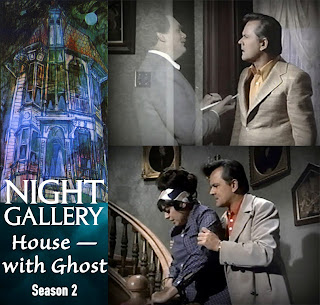
Spooky season is right around the corner, so what better time to talk about Rod Serling's Night Gallery? I am certainly not alone when I say I am a great fan of Rod Serling's The Twilight Zone and Night Gallery. So just imagine my excitement when, earlier this year, I was invited to provide audio commentary for the episode "House, with Ghost" (starring Bob Crane, Jo Anne Worley, and Bernard Fox) in the bonus features section of the Night Gallery Season 2 DVD Blu-Ray release!

Letmethinkaboutit—Yes!

I was interviewed and recorded in the spring, and I am very happy with how the producers used my audio clips. In addition to my segments, the entire bonus commentary over the episode includes the narrator, who provides historical details of the episode (some based on my interview and our book Bob Crane: The Definitive Biography), as well as audio clips from notables affiliated with Night Gallery. Also featured in the bonus section is a segment of Bob's KNX radio interview with Rod Serling. 

Needless to say (but I'm gonna say it anyway), representing Bob in the audio commentary of his episode, as well as simply being a part of Rod Serling's Night Gallery, is such an honor, to say the least. Many thanks to Night Gallery DVD producer Jim Benson for this wonderful opportunity!

The 2022 re-release of Night Gallery Season 2 on HD/Blu-Ray was released in July 2022 and is available through Amazon and elsewhere.

Monday, July 25, 2022

Defender of the Truth: In Loving Memory of Bob Crane's Cousin Jim Senich

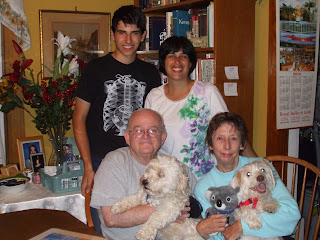
Jim Senich and his wife, Ellen (seated, front).
Linda Groundwater and her son, Andrew (back).
Summer 2010.
I learned today of the passing of Jim Senich.

I first met Jim when I decided to embark on the journey of writing Bob Crane: The Definitive Biography. I was given his name and contact details, because he worked in Connecticut radio, and Bob was his first cousin. I was hoping that he would be able to give me some information and that he would have some stories to tell, and perhaps other contacts. He, himself, was a contact.

But Jim became so much more than that. Not only did he succeed spectacularly at what I hoped for from a writer's point of view, he shared himself. He shared his family. He shared his home. He shared his friendship. Jim and his wife Ellen and their daughter Mary welcomed me and my son Andrew into their home when we visited back in 2010. I remember two sweet doggies. A wonderful Italian dinner. Music! Books! And hours of talk and laughter and true to heart, genuine conversation. A trip around Waterbury, and a sit-down in a local park, where we just spoke about life and its unexpectedness. And he was so happy to know Andrew, who nearly shared Jim's birthday—the two being born a day apart (though vastly different in years). He sent packages with baseball themed gifts even before they met in person, and my little boy, he was happy. And he knew he had a real friend in his "almost" birthday twin.

Life wasn't always fair to the "Great Dane," but Jim tried his hardest to look at it from a larger perspective. He was so proud of his family, and he had every reason to be. We did lose touch, in the end. I regret that. But I will hold him close in my heart, with thanks for all he was, and for all he is.

Jim, may you rest in eternal peace with the Lord that you love. Thank you for everything, my friend. Your memory will be in my heart always.

Linda Groundwater
July 25, 2022

Tuesday, June 28, 2022

Dead Again...and Again: The Murder and Ongoing Destruction of Bob Crane

On June 29, 1978, Bob Crane was murdered in his sleep. He was just 49 years old, and only a couple of weeks shy of his 50th birthday. Despite numerous unproven theories, the crime remains officially unsolved to this day.

Following his murder, information about Bob's private life surfaced. It was placed on display for all to see—and judge, with no explanation or perspective. The cry rang out: Bob Crane, beloved star of Hogan's Heroes, had a secret "dark side." 

Over the decades, this side of his life has obscured nearly all else about him, and the proliferation of articles, television shows, documentaries, books, YouTube videos, and podcasts focusing on true crime and vulgar humor—not to mention Auto Focus—is unending and unrelenting. Bob Crane's sex addiction and unsolved murder are lucrative as well as convenient for a cheap punchline to a bad joke.

Since our book, Bob Crane: The Definitive Biography, was published in 2015, we have continued to actively tell Bob's story with proper perspective to allow a more profound understanding of Bob as a complete human being. This is not an easy task. Just as researching Bob's life had its hurdles and barriers, so does being his official biographers. We've heard it all and seen it all. And a lot of what we've seen and heard from those who did not know Bob but who only think they know him—is just plain ugly.

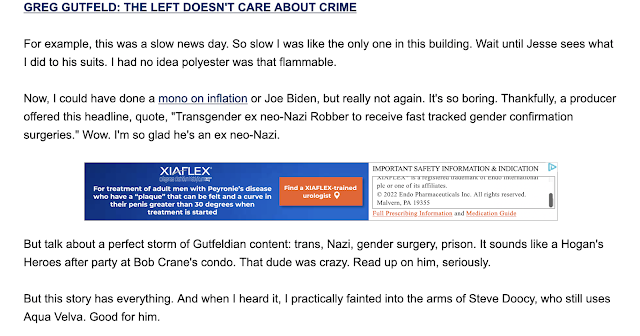
Take, for instance, Fox News host Greg Gutfeld. Mr. Gutfeld thinks he is being so funny in his article, entitled, "Bad People Abuse Good Intentions," when he talks about a "transgender ex-Nazi bank robber." 


Mr. Gutfeld states:

Now, I could have done a mono on inflation or Joe Biden, but really not again. It's so boring. Thankfully, a producer offered this headline, quote, "Transgender ex neo-Nazi Robber to receive fast tracked gender confirmation surgeries." Wow. I'm so glad he's an ex neo-Nazi. But talk about a perfect storm of Gutfeldian content: trans, Nazi, gender surgery, prison. It sounds like a Hogan's Heroes after party at Bob Crane's condo. That dude was crazy. Read up on him, seriously. 

What on earth? What an uneducated word salad.

Let me remind everyone: Bob Crane had consensual sex with adult women only, whom he often photographed or videotaped with their knowledge and willingness to participate. Further, in the months leading up to his murder, Bob was seeking professional counseling in the attempt to break free of this lifestyle, which he came to understand and recognize as an addiction. He was hoping to better his life, but he was denied that opportunity because someone took his life away from him. In that moment, when his murderer bludgeoned him as he slept, that evil monster took away Bob's life and dreams of the future, as well as shattered not only his friends and loved ones, but his legacy as well. 

Murdered. Judged. Ridiculed. Legacy destroyed. 

We do know his true story. We do care. And so we tell his story. Often. Every chance we get.

Bob's so-called "dark side" is actually kind of boring. For those who take the time to learn about Bob, it becomes quite clear. Yet there are those who still try to be funny by resorting to their meager inventions of alternative facts to suit their pathetic narrative in the attempt to boost their ratings and generate sales. How heartless.

Co-Bob Crane biographer Linda Groundwater has this to say about Gutfeld's statement, and I whole-heartedly agree:

Carol sent me a message that included an excerpt from an article online by Greg Gutfeld from Fox. Ignoring the entire rest of the article (let's not bring politics into this, shall we?), there was this little bombshell in his commentary: 

"But talk about a perfect storm of Gutfeldian content: trans, Nazi, gender surgery, prison. It sounds like a Hogan's Heroes after party at Bob Crane's condo. That dude was crazy. Read up on him, seriously." 

It went right over my head the first time. I couldn't even fathom what I was seeing. I read it again. And then again. And it made me angry. It made me SO angry. Forty-four years ago this week, Bob Crane was murdered. An addict, yes. A man who had a lot of sex, sure. But a human being. A man who tried. A man who had consensual sex with women. Not a person who deserved to be the butt of some weak, derisive, throwaway humor by some hack out to get a guffaw through his ignorance of truth. 

People ask us all the time, why do we do what we do? 

THIS IS WHY. Feel free to direct Mr. Gutfeld to reality. You're never too old to be educated. And if he has the tiniest, tiniest, sliver of humanity in him, he'll take us up on the challenge to actually learn the truth. Somehow, I doubt he'll do it. Because people who make jokes like this about Bob rarely want to learn. It's easier to point and laugh and stay ignorant than it is to see his humanity. 

Bob deserves better. We will NEVER stop.

Linda J. Groundwater
June 28, 2022 
Monday, August 30, 2021

Bob Crane: Family Videos

During the course of what is now nearly two decades, my coauthors—Linda Groundwater and Dee Young—and I have seen and heard just about everything there is relating to Bob Crane's life and tragic death. As his official and authorized biographers, we have been granted exclusive permission to view and entrusted with Bob's personal belongings. Perhaps one of the most important pieces of research we've reviewed, however, is a movie reel. 

When you say the words movie reel in the same sentence as the name Bob Crane, how many of you thought of one thing? For the record (again), Bob engaged in amateur pornography with adult, consensual women who agreed to be filmed. (Yes, it's been investigated by the authorities, and yes, the women knew they were being filmed. Enough said—until the next time we have to say it.) 

Now that you've gotten that out of your system... 

The simple truth is that Bob recorded everything. He audio recorded. He photographed. He filmed. He journaled. He catalogued. He chronicled. And he did this with every single aspect of his life from the time he was a teenager throughout his entire life. When you put it all into perspective, the "naughty bits" constituted just a small piece of a much larger collection that was primarily composed of Bob's every day life.

In our opinion, one of the most important pieces of footage Bob Crane filmed was on Father's Day—June 18, 1978, just ten days before his murder. His wife Patty (Sigrid Valdis) and their son Scott had arrived in Scottsdale on a surprise to visit him. Reports claim he was upset by their visit. Bob and Patty were separated at the time and on the brink of divorce. However, Bob invited them over to his Scottsdale apartment. Because it was Father's Day, they gave him cards and a gift. Bob could never have imagined that in just under two weeks and right before his 50th birthday, his life would be cut short in that very same location, just a few yards from the living room where he received his cards and gift from Scotty, then just seven years old. 

To this day, Bob's murder remains unsolved. A great deal of speculation surrounds the murder of Bob Crane and who may have killed him, with much emphasis on John Henry Carpenter (different from the film director) as the primary suspect. In 1992, he was arrested. A trial followed, and in 1994, Carpenter was found not guilty. Arm chair detectives have a field day with this unsolved case, discussing their theories, making their jokes, deciding who they believe must have done it. 

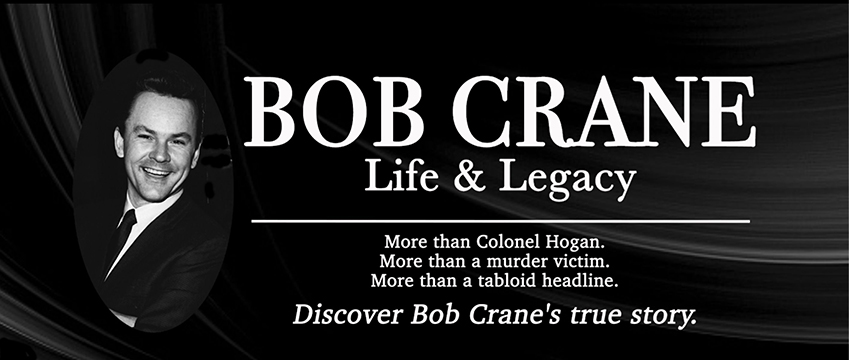
Back to Father's Day 1978. I watched the Bob's family video taken on Father's Day 1978 for the first time while visiting Scott in 2013. I sat in Scott's living room with him, his then-soon-to-be wife, and his children, and we watched. And as I watched, I was mesmerized. Here was Bob Crane, the regular guy—a husband and father who didn't want his marriage to end. Not famous Colonel Hogan or radio personality; not murder victim; not tabloid headline. Since then, I have wished more people could see what I was seeing. This footage showed me, without question, how much of a loving father Bob was. It showed me how much he adored his family—just absolutely cherished his family, especially his children. And it proved without a doubt how much in love he was with his  wife—and how much she loved him, too, despite their marital troubles. 

When Linda was interviewed for the Autopsy episode about Bob Crane in November 2020, which aired in June 2021, she mentioned this video to the producers when talking about Bob as a family man who loved his family. They were astonished. They asked Linda, "How do you know about this video?" And Linda responded bluntly, "Because I have seen it."

Scott Crane has now made this video available to the public. I am so very happy he has done so because now you can see for yourself. This is not play acting for an audience. This is family. 

These are Bob Crane's home movies of himself and the people he loved: his wife, his children, his parents, and his friends. Bob Crane was a human being. He was also murdered. And his family and friends are still deeply affected by and mourn his loss.

No unauthorized use of any portion of this video—audio or video—is allowed without written permission of Robert Scott Crane. 
For all permission requests, click here.

Saturday, August 28, 2021

'Hogan's Heroes' Revue: The Pilot — How It Differed from the Series

Hogan's Heroes is often considered the older cousin of MASH. When studying the two shows, you can see very clearly how MASH was allowed to evolve in a much more dramatic way than Hogan's Heroes ever could. But that doesn't mean Hogan's Heroes didn't evolve. It did, and by quite a bit.

After the pilot episode was filmed and then picked up by CBS for broadcast, drastic changes were made to the series. In the latest episode of 'Hogan's Heroes' Revue, Linda Groundwater and Carol Ford discuss the pilot episode. They offer a comparison to MASH, as well as other episodes, to provide insight into how pilots are vastly different from the series, as well as how a series can grow and evolve. They discuss Hogan's Heroes casting, set, and style changes, and they also talk about the purpose of pilot episodes in general and the importance of character actors.

Obviously, the series was produced by the company Bing Crosby Productions. However, Edward H. Feldman was the Executive Producer who needed to answer to the head of CBS—first James Aubrey, and after his dismissal in 1965 (very soon after Hogan's Heroes was picked up), John "Jack" Schneider. Without the approval of CBS, Hogan's Heroes would not have been picked up and aired, no matter which company produced it. Through his tenacity, Edward Feldman was able to make changes to the series that CBS granted, including the switch from black and white to color, among other style, actor, and set changes.

We hope you enjoy this episode of 'Hogan's Heroes' Revue!

Listen to "03. The ‘Hogan’s Heroes’ Pilot: How 'The Informer' Differed from the Rest of the Series" on Spreaker. Listen to "04. Commentary Series — ‘Hogan’s Heroes’ Episode #1: ‘The Informer’" on Spreaker.

Tuesday, July 13, 2021

Happy Birthday Bob Crane!

Happy Heavenly Birthday Bob Crane! 

Today, July 13, 2021, Bob Crane would be 93 years old. 

Bob was not only the star of Hogan's Heroes, but he was an accomplished drummer and gifted musician, a broadcasting pioneer who was described as a radio genius by those who worked with him, a dear friend to many, a loving father, a humanitarian who genuinely cared about others, and a complete and complex human being, no different than the rest of us.

"Everybody has a history to his or her life. Let’s not paint Bob’s life by—what shall we say?—the moments in his life. I say these things that are the flaws are like specks on the Parthenon. Let’s look at the Parthenon and let’s not look at the specks. Let’s lift our eyes up to the man’s eyes and soul and life, and not look down on the gutter." —Joe Cosgrove, former staff announcer, KPOL, Los Angeles, and owner, KTHL, Lake Tahoe, CA; the first person to greet Bob when he arrived in Hollywood in August 1956. © Bob Crane: The Definitive Biography

And with that, we also say Happy Enarc-Drof Week! Don't know what that is? Listen to our birthday celebration podcast episode to find out! 

Listen to "012. The Lucky Number 13" on Spreaker.

Tuesday, June 29, 2021

Review of 'Autopsy: The Last Hours of Bob Crane' [Podcast]


Today, June 29, 2021, marks 43 years since Bob Crane's tragic murder. A few weeks ago, Linda Groundwater was featured in the Reelz program Autopsy: The Last Hours of Bob Crane as one of Bob's official biographers. In this episode of our podcast, Flipside: The True Story of Bob Crane, we provide an in-depth review of this 'Autopsy' episode.

Special thanks to Robert Scott Crane, who is our featured guest in this podcast episode, and to another source who has chosen to remain anonymous at this time.

Rest in peace, Bob. As long as we can continue to help people see and understand your true story, as Linda says in our podcast, "We'll keep working."

Listen to "011. Review of ‘Autopsy: The Last Hours of Bob Crane’" on Spreaker.

Subscribe to Flipside: The True Story of Bob Crane on Apple Podcasts, Google Podcasts, Spotify, Stitcher, TuneIn Radio, Spreaker, YouTube, and everywhere podcasts are found.

Monday, June 14, 2021

Autopsy: The Last Hours of...Bob Crane [Preview of Episode Review]

Autopsy: The Last Hours of... Bob Crane, featuring Linda Groundwater as an expert on Bob Crane's life and coauthor of Bob Crane: The Definitive Biography, premiered last night (Sunday, June 13, 2021). Now that the episode has aired, we have some things to say. 

To recap, Linda did a fantastic job in the episode. She provided some perspective about Bob's life and balanced out some of the negative stuff. Kudos to Linda! TV interviews are tough, and she was brilliant.

Autopsy got a lot of things right, and for that (as well as the scientific nature of the program), it was one of the more evidence-based shows that Reelz typically produces. 

But Autopsy also got some things wrong, and those parts need clarification and addressing.

Mind you, just because we don't like to focus on Bob's murder and sex addiction in our work about him, it most certainly does not mean we don't know the details about it or thoroughly understand it.

We'll be discussing all of this in our next episode of Flipside: The True Story of Bob Crane. Stay tuned.


Sunday, June 6, 2021

Autopsy: The Last Hours of... Bob Crane [Reelz Network; June 13, 2021]


Autopsy: The Last Hours of... Bob Crane
Date: Sunday, June 13, 2021
Time: 9:00 p.m. EDT
Featuring: Linda J. Groundwater, co-author of Bob Crane: The Definitive Biography and official Bob Crane co-biographer

On June 13, 2021, Autopsy: The Final Hours of... with Dr. Michael Hunter, will show the episode delving into the life and death of Bob Crane. Although we all know how Bob died, a bit of insight into his life and his struggles and successes would help give a bit of a fuller picture. The English production team interviewed Linda Groundwater in Australia as part of the larger program last November, and Linda spent a bit of time dispelling myths and correcting long held false information.

Wednesday, May 12, 2021

'Hogan's Heroes' Revue — A New Podcast

It should come as no surprise that in Bob Crane: The Definitive Biography, the chapter focusing exclusively on Bob Crane's work on Hogan's Heroes is over 100 pages in length. Although Bob was hailed as a radio genius by those who worked with him in the broadcasting industry, Hogan's Heroes put him on the international stage. After its initial success and six-season run, Hogan's Heroes made Bob Crane and the rest of the cast super stars of their day.

When researching Bob Crane's life, we talked with as many people from his life as we could, and this included many prominent individuals from Hogan's Heroes—co-creator Albert S. Ruddy; cast members Robert Clary and Cynthia Lynn; guest stars Arlene Martel, Robert Hogan, Victoria Carroll, Jon Cedar, and Ruta Lee, among others; and directors, including Bruce Bilson, Robert Butler, and Jerry London. We also researched countless published contemporary articles about Hogan's Heroes and the cast, and had exclusive access to Bob Crane's own Hogan's Heroes scrapbooks and files.

Combine all of that research with the fact that we love Hogan's Heroes, and you've got the groundwork for another podcast.

Linda Groundwater, Dee Young, and I currently produce Flipside: The True Story of Bob Crane. But we wanted more. (We can't help it if we're greedy...!) And a podcast about Hogan's Heroes was begging to be produced. So we have launched a second podcast, 'Hogan's Heroes' Revue, where Linda and I will talk about each episode, starting with the pilot; include details from series insiders; and produce some of what is considered the best Hogan's Heroes fan fiction out there.

There's also a reason why we named it 'Hogan's Heroes' Revue, but you'll have to listen to our preview episode to find out!

Enjoy!

Listen to "01. Preview of 'Hogan's Heroes' Revue" on Spreaker.

Thursday, April 15, 2021

Bob Crane's 1978 Appearance on 'Celebrity Cooks' [Podcast]

It's so fantastic and extraordinary, it's become urban legend when discussing the final months of Bob Crane's life.

Celebrity goes on a national Canadian TV cooking show; breaks down; falls apart; rants about death, sex, and his impending divorce; is brought to tears; and shocks the studio audience. A station network executive pulls the episode from syndication following celebrity's murder because of an eerie sense of deja vu and premonition of the crime, as well as celebrity's depressed state and inability to stop talking about death and sex during the show's taping.

Such is the case with Bob's appearance on the Canadian television series, Celebrity Cooks

Or is it?

Bruno Gerussi and Bob Crane on Celebrity Cooks, January 25, 1978.
Photograph by Ron Goldman.

While researching Bob's life for Bob Crane: The Definitive Biography, Linda Groundwater and I talked with three people directly affiliated with Celebrity Cooks: owner Derek Smith, talent agent Anne Kear, and stage manager Roger Packer. A fourth person connected with the series, photographer Ron Goldman, also provided a statement. All four were present on the day of Bob's episode taping, and all four emphatically agree—everything we thought we knew about Bob Crane's appearance on Celebrity Cooks, as based on a 1978 magazine article, referenced in Robert Graysmith's book The Murder of Bob Crane, and depicted in Auto Focus, is wrong.

In our latest episode of Flipside: The True Story of Bob Crane, Linda and I discuss Bob's appearance on Celebrity Cooks. We take apart the 1978 article that started the whole myth, and we provide answers from Celebrity Cooks as well. It will never cease to amaze Linda, me, or the folks from Celebrity Cooks that this brief moment of Bob's life, which is held up as an example of his life falling apart, never actually happened.

Listen to "09. Bob Crane’s 1978 Appearance on 'Celebrity Cooks'" on Spreaker.


For an earlier post about Bob Crane's appearance on 'Celebrity Cooks,' click here.

Monday, March 29, 2021

Becoming Colonel Hogan

Let's be honest. Bob Crane's German accent on Hogan's Heroes was pretty bad. In fact, it was terrible. It seemed everyone on the series could perform a decent (or in some cases, exceptional) German accent except for Bob. Larry Hovis (Sgt. Andrew Carter) was so good at it, in fact, that he could pull off a convincing—and a bit frightening—Adolph Hitler. 

But where others excelled, Bob seemed to fail. To some, it may even be a bit painful to hear him fumble a German accent with American accent overtones. Had this been real life, the Germans would have caught him in a New York minute.

Yet Bob was a gifted voice impersonator, having honed the skill in radio for fifteen years. In Hollywood, he was hailed as radio's "Man of a Thousand Voices" by KNX. He worked with Mel Blanc on a pilot for a new radio program, Superfun. And one of his first television "roles" was as the uncredited voice announcer in The Twilight Zone episode "Static," where he provides all of the voices on the radio.

It begs the question: If Bob Crane could perform all sorts of accents on his radio program, from a French fashion designer to race car driver Andy Granatelli, to an Einstein-sounding engineer, to a love-struck Russian, to a host of other "character" voices, then why could he not perform a decent (or even passable) German accent on Hogan's Heroes?

Simply, he was told—directed—to do it poorly. The directors thought it would be funny. "He wasn't supposed to do it well!" director and associate producer Jerry London told Linda Groundwater and me in our interview for Bob Crane: The Definitive Biography. "That was the comedy of it!" he said.

Linda and I discuss this in our latest episode of our podcast, Flipside: The True Story of Bob Crane. Bob didn't just become Colonel Hogan overnight. He was still quite inexperienced as an actor at the start of the series. This doesn't make him a bad actor, though. 

Early on his acting career, which consisted of community "little" theatre, guest-starring roles on The Alfred Hitchcock Hour and The Twilight Zone, his big break on The Dick Van Dyke Show, and eventually, the regular role of Dr. Dave Kelsey on The Donna Reed Show, Bob made a decision to take acting seriously. He accepted coaching advice from Donna Reed, and in addition, at her suggestion, he took a course taught by legendary acting instructor Stella Adler. 

While the Hogan's Heroes directors and producers, and viewers of the series in its original run by extension, may have thought Bob Crane doing a botched German accent was funny at the time, it unfortunately does not age well. Viewers today watch and think Bob couldn't act, or worse, didn't care to learn how to act. This wasn't the case. He was following direction. And when a director tells you to do something, you do it. 

Indeed, Bob was learning. He came a long way on Hogan's Heroes. People learn throughout their entire lives, and the same was true for Bob. He continued to learn and hone the craft until the time of his murder in 1978. Many actors who worked with him believe he would have had found another hit series and enjoyed continued success as an actor and/or director had he lived.

In the end, Hogan's Heroes is a television show. We're supposed to suspend our belief and understand that no matter whether the German accent was good or bad, all of the heroes are speaking fluent, flawless German. Otherwise, they would have likely failed their first mission, right out of the gate. 

Listen to "08. Becoming Colonel Hogan" on Spreaker.